
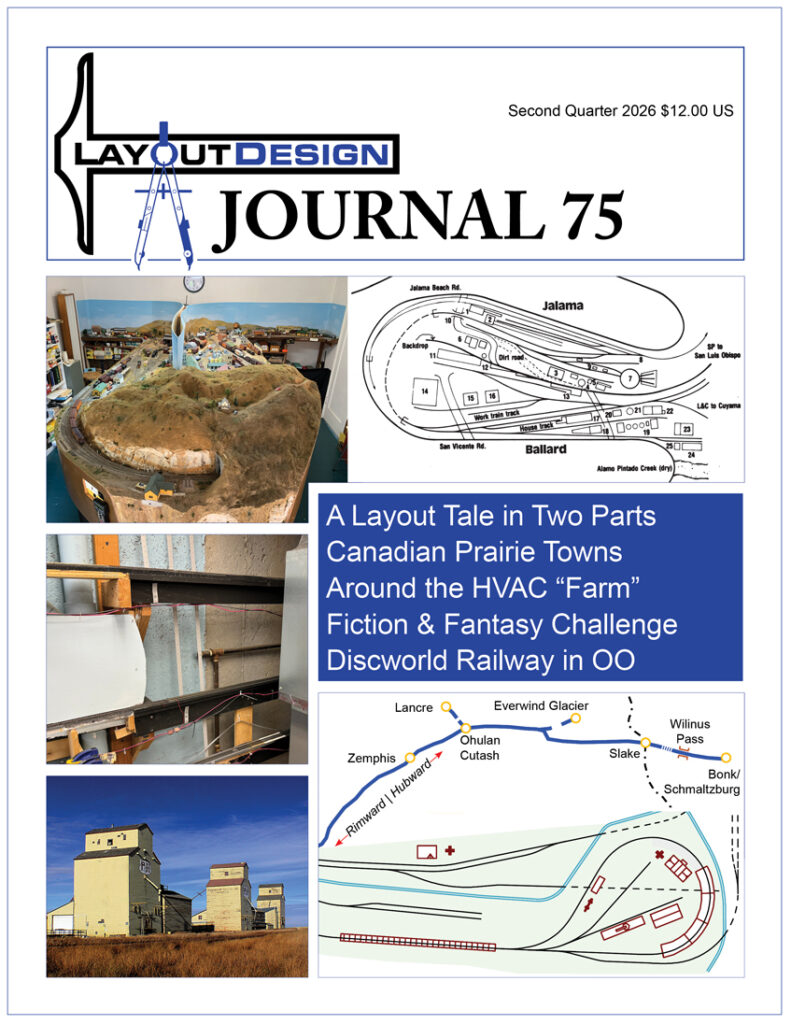
The Layout Design Journal (LDJ), Issue 75 (Second Quarter 2026)
Magazine Summary
Layout Design Journal 75 explores how layout designers adapt prototype practices, operational goals, physical limitations, and creative concepts into successful model railroad designs. Across the issue, authors examine layout evolution, prototype research, operations-based planning, space utilization, and the application of design principles to both real and fictional railroads.
A major theme is the relationship between prototype inspiration and selective adaptation. Tony Thompson examines the evolution of two generations of his Southern Pacific Coast Line layout, comparing earlier design decisions involving extensive hidden staging and freelanced operations with a later version emphasizing visible running, prototype fidelity, and improved switching opportunities. Cal Sexsmith provides an extensive study of Canadian prairie railroad towns, documenting standardized town and track arrangements used by Canadian Pacific, Canadian Northern, and Grand Trunk Pacific railways while demonstrating how those patterns informed the design of his own operating layout.
The issue also expands beyond traditional prototype modeling through the Fiction & Fantasy Design Challenge and the accompanying Discworld Fantasy Railway article. Together these pieces demonstrate that established layout design principles remain applicable when designing fictional railroads. Concept development, operational planning, scenic storytelling, and space planning are shown to be equally valuable whether the inspiration comes from a real railroad or an imagined world.
Operations-based design appears throughout the issue. Authors discuss staging strategies, branch line operation, freight handling, run-around tracks, mixed trains, switching districts, grain elevator traffic, passenger operations, and traffic generation. Several articles emphasize how operational requirements should influence track planning decisions.
Space constraints and physical limitations form another recurring theme. Andre Jackson demonstrates innovative benchwork techniques for routing railroad trackage around household mechanical systems, while Norm Bruce shows how meaningful operation can be achieved within the limitations of a ten-turnout challenge. Eric Hansmann highlights practical design concepts observed on Bill Neale’s Pennsylvania Railroad layout, including signal repeaters, backdrop treatment, scene depth, and staging design.
Scenic presentation and visual storytelling are also important themes. Authors discuss geographic authenticity, prototype vegetation, railroad town development, backdrop integration, scenic transitions, and the use of scenery to communicate both real and fictional settings.
Overall, LDJ-75 is valuable to layout designers interested in prototype-inspired planning, operational design, layout evolution, railroad town modeling, space-constrained design, and creative applications of layout design methodology. The issue demonstrates that successful layouts emerge from balancing operational goals, prototype inspiration, available space, and thoughtful design trade-offs.
Table of Contents
Articles
Compact Calif. Central Coast – Again: A Tale of Two Layouts – Tony Thompson – Page 4
Modeling Canadian Prairie Towns: Typical Railroad-Town Track Arrangements on CP, CN & GTP – Cal Sexsmith – Page 11
Fiction & Fantasy Design Challenge – Byron Henderson – Page 25
Discworld Fantasy Railway in OO: Key Scenes from Raising Steam Plus a Skosh of Operation – Byron Henderson – Page 26
Designing Around the HVAC “Farm”: An Innovative Use of L-Girders to Maximize Layout Space – Andre Jackson – Page 33
GC&SF Agrarian Branch in 10 Turnouts: 1950s Operations-Oriented Santa Fe Layout in HO – Norm Bruce – Page 36
Design Ideas from Bill Neale’s PRR – Eric Hansmann – Page 37
News and Departments
Preparing to Pass the Baton – Byron Henderson – Page 3
Changes and Growth – Ron Burkhardt – Page 3
Help us Share the SIG Through Free Back Issues – Page 10
Thanks to the Bay Area Meet 2026! – Page 23
The LDJ Wants You! Editor Search Underway – Page 24
Upcoming Design and Ops Meetings – Page 38
Election Results; Call for Candidates; AGM – Ron Burkhardt – Page 39
Have You Seen LDSIG on the ‘Tube? – Page 40
Detailed Article Summaries
Title: Compact Calif. Central Coast – Again: A Tale of Two Layouts; Page 4
Author: Tony Thompson
Railroad Modeled: Southern Pacific (SP); Proto-freelanced Santa Rosalia Branch
Location: California Central Coast; Coast Line; Oceano area; Santa Maria region
Era: Steam-to-Diesel Transition Era
Layout Scale: HO
Layout Size: Original layout 16′ x 19′; Current layout approximately 15′ x 15′
Techniques: Proto-freelancing; Branch line design; Staging design; Hidden staging; Multi-deck design; Slide-out staging table; Layout evolution; Operations planning; Continuous run; Industry switching; Waybill operations; California scenery modeling; Selective compression
Article Summary:
Tony Thompson compares two generations of layouts based on Southern Pacific operations along California’s Coast Line. The original Pittsburgh layout combined a visible Southern Pacific main line with the freelanced Lompoc & Cuyama Railroad. Extensive hidden staging and long grades provided operating flexibility but reduced visible train running and limited train lengths.
The article describes the original railroad’s operation using car cards, cab control, multiple crews, and interchange traffic. Thompson evaluates the benefits and drawbacks of large staging yards and extensive underground running, concluding that operational flexibility came at the cost of visible railroad activity.
The later Berkeley layout retained portions of the original railroad while eliminating the extensive hidden grades. A level main line, slide-out staging table, and redesigned branch line improved both operations and maintenance. The freelanced railroad became the proto-freelanced Santa Rosalia Branch, allowing all equipment, structures, and scenery to conform to Southern Pacific practice.
Additional industries and switching districts were added at East Shumala and Santa Rosalia, increasing operational complexity. Scenic efforts focused on accurately representing California coastal vegetation and landscape patterns. The article demonstrates how layout redesign can improve operational effectiveness while preserving successful features from earlier construction.
Revised: 2026-06-10
Title: Modeling Canadian Prairie Towns: Typical Railroad-Town Track Arrangements on CP, CN & GTP; Page 11
Author: Cal Sexsmith
Railroad Modeled: Canadian Pacific Railway (CPR); Canadian National (CN); Grand Trunk Pacific (GTP)
Location: Saskatchewan and Alberta prairie regions
Era: Early 1900s–1980s
Layout Scale: HO
Layout Size: Multi-town multi-deck layout; approximately 48 feet of modeled railroad
Techniques: Prototype research; Historical track charts; Prairie railroad design; Grain elevator operations; Branch line operations; Junction design; Terminal design; Multi-deck planning; Prototype compression; Traffic generation; Staging design; Railroad town planning
Article Summary:
Cal Sexsmith examines the standardized railroad town designs developed by Canadian railroads during western expansion. Using numerous prototype examples, he documents common arrangements of main tracks, sidings, business tracks, grain elevators, stock pens, fuel dealers, freight facilities, and stations.
The article categorizes prairie towns into two-switch towns, four-switch towns, junction towns, and terminal towns. Examples including Meath Park, Springside, Choiceland, Foam Lake, Debden, Medstead, Hillmond, and Meadow Lake illustrate how railroad companies balanced operational requirements, community development, and future expansion.
Detailed discussion is provided regarding grain elevator operation, stock handling, team tracks, fuel dealers, locomotive servicing, and station functions. The article explains how railroad companies often designed entire communities in conjunction with railroad construction.
Sexsmith then demonstrates how prototype arrangements informed his own layout design. His model railroad selectively compresses prototype locations while preserving operational characteristics and traffic patterns. The article serves as both a prototype planning reference and a practical guide to modeling Canadian prairie railroading.
Revised: 2026-06-10
Title: Fiction & Fantasy Design Challenge; Page 25
Author: Byron Henderson
Series: LDSIG Design Challenge
Railroad Modeled: N/A
Location: N/A
Era: N/A
Layout Scale: Any Scale
Layout Size: Designer Defined
Techniques: Design challenge concepts; Freelance design; Fantasy layout design; Theme-based layout design; Conceptual planning; Scenic storytelling; Operations planning; Creative design development; Layout design methodology; Prototype adaptation; Track planning; Presentation techniques
Article Summary:
This article introduces the LDSIG Fiction & Fantasy Design Challenge and establishes the framework for designers to explore layout concepts inspired by literature, fantasy worlds, cartoons, games, science fiction, and other fictional settings. Unlike previous design challenges that focused on prototype railroads or traditional freelance concepts, this challenge encourages participants to develop layouts whose primary inspiration comes from imaginative sources while still applying sound layout design principles.
The article emphasizes that successful entries should communicate the essence of the selected theme through track arrangements, scenic treatments, structures, operating patterns, and overall presentation. Designers are encouraged to move beyond simple decorative interpretations and instead create layouts where the design itself reinforces the fictional narrative.
Participants are asked to submit scale track plans, benchwork boundaries, operational concepts, and explanatory text describing how their designs function. Although the subject matter may be fictional, practical considerations such as access, curve radius, turnout selection, staging, and operating reliability remain important. The challenge therefore serves as an exercise in applying proven layout design methods to non-traditional subjects.
The article also outlines publication requirements, submission procedures, and editorial assistance available through the LDJ. It functions both as a design challenge announcement and as a discussion of how layout design methodology can be extended beyond prototype railroading into imaginative modeling subjects.
Revised: 2026-06-10
Title: Discworld Fantasy Railway in OO: Key Scenes from Raising Steam Plus a Skosh of Operation; Page 26
Author: Byron Henderson
Series: Fiction & Fantasy Design Challenge
Railroad Modeled: Discworld Railway
Location: Discworld; Ankh-Morpork; Sto Lat; Bonk/Schmaltzburg; Quirm
Era: Fictional Steam Era
Layout Scale: OO
Layout Size: Approximately 12′ x 37′
Techniques: Conceptual design; Footprint design; Detail design; Theme-based planning; Fantasy railroad design; Operations planning; Scenic storytelling; Return loops; Branch line design; Concept development; Layout methodology
Article Summary:
Byron Henderson demonstrates the application of formal layout design principles to a fictional railroad based on Terry Pratchett’s Discworld novel Raising Steam. The article illustrates that effective design methodology remains useful even when no real-world prototype exists.
Beginning with conceptual planning, Henderson identifies important locations, industries, scenes, and operational themes described in the novel. These concepts are then translated into a practical layout plan through footprint design and detailed track planning.
The resulting design includes passenger terminals, freight yards, branch lines, mining operations, customs facilities, mountain scenery, and significant locations from the book. Operational opportunities include passenger trains, freight service, mining traffic, ice traffic, and branch line switching.
The article also explores space planning, train-length considerations, passing sidings, grade placement, scenic priorities, and operating flexibility. The final design balances literary inspiration with practical operating requirements and demonstrates how layout design techniques can support storytelling as effectively as prototype replication.
Revised: 2026-06-10
Title: Designing Around the HVAC “Farm”: An Innovative Use of L-Girders to Maximize Layout Space; Page 33
Author: Andre Jackson
Railroad Modeled: N/A
Location: N/A
Era: N/A
Layout Scale: HO
Layout Size: Approximately 11′ x 53′
Techniques: Benchwork design; L-girder construction; Space planning; Mechanical system accommodation; Multi-level construction; Structural design; Layout access planning
Article Summary:
Andre Jackson describes the challenge of incorporating a layout into a basement containing extensive mechanical equipment. Traditional approaches would have required sacrificing significant layout space or constructing complex removable sections.
After evaluating alternatives, Jackson chose to route trackage behind the HVAC equipment rather than in front of it. This preserved operational space while maintaining access to household systems.
The article details the construction of narrow wall-mounted L-girder benchwork supporting multiple levels of track within a confined corridor. Structural considerations, utility clearances, support systems, and maintenance requirements are discussed in detail.
The completed installation successfully accommodates multiple levels of trackage while preserving valuable layout space. The article serves as a practical example of adapting layout design to difficult room conditions through innovative benchwork construction.
Revised: 2026-06-10
Title: GC&SF Agrarian Branch in 10 Turnouts: 1950s Operations-Oriented Santa Fe Layout in HO; Page 36
Author: Norm Bruce
Series: Ten Turnout Challenge
Railroad Modeled: Atchison, Topeka & Santa Fe (ATSF)
Location: Central Texas; Lometa; San Saba; Brady; Menard
Era: 1950
Layout Scale: HO
Layout Size: 10′ x 24′
Techniques: Small-layout design; Branch line operations; Mixed trains; Staging design; Selective compression; Passing sidings; Minimal-turnout planning; Operations-based design
Article Summary:
Norm Bruce presents a branch line layout based on the Santa Fe’s San Saba Branch in Texas. Developed as part of the LDSIG Ten Turnout Challenge, the design demonstrates how substantial operating interest can be achieved with a limited number of turnouts.
The railroad serves agricultural and ranching communities, generating livestock, wool, mohair, locomotive sand, passenger, and freight traffic. Three staging tracks represent off-layout destinations and origins.
Each modeled town includes a passing siding and industry spurs that support realistic switching rather than puzzle-style operation. Operating sessions feature mixed trains, local freight service, stock traffic, and sand trains.
The article demonstrates how prototype-based operations and meaningful traffic flows can be maintained even within strict design limitations.
Revised: 2026-06-10
Title: Design Ideas from Bill Neale’s PRR; Page 37
Author: Eric Hansmann
Railroad Modeled: Pennsylvania Railroad Panhandle Division
Location: N/A
Era: N/A
Layout Scale: N/A
Layout Size: Large Multi-Deck Layout
Techniques: Multi-deck design; Signal repeaters; Backdrop design; Scene depth; Layout presentation; Staging design
Article Summary:
This article highlights several design techniques observed on Bill Neale’s Pennsylvania Railroad Panhandle Division during NMRA convention layout tours. The focus is on practical ideas that can be adapted to other layouts.
Examples include signal repeaters that improve operator visibility without requiring crews to lean over scenery, techniques for visually minimizing room supports, and methods of increasing apparent scene depth through building placement and backdrop treatment.
The article also illustrates efficient staging arrangements and multi-deck construction methods. Collectively, the examples demonstrate how relatively small design details can significantly improve both operation and presentation.
Revised: 2026-06-10
Download a free sample of pages from this issue.
To download the issue login to your member account: click “here“.
Non-members can join or renew: Click “here“