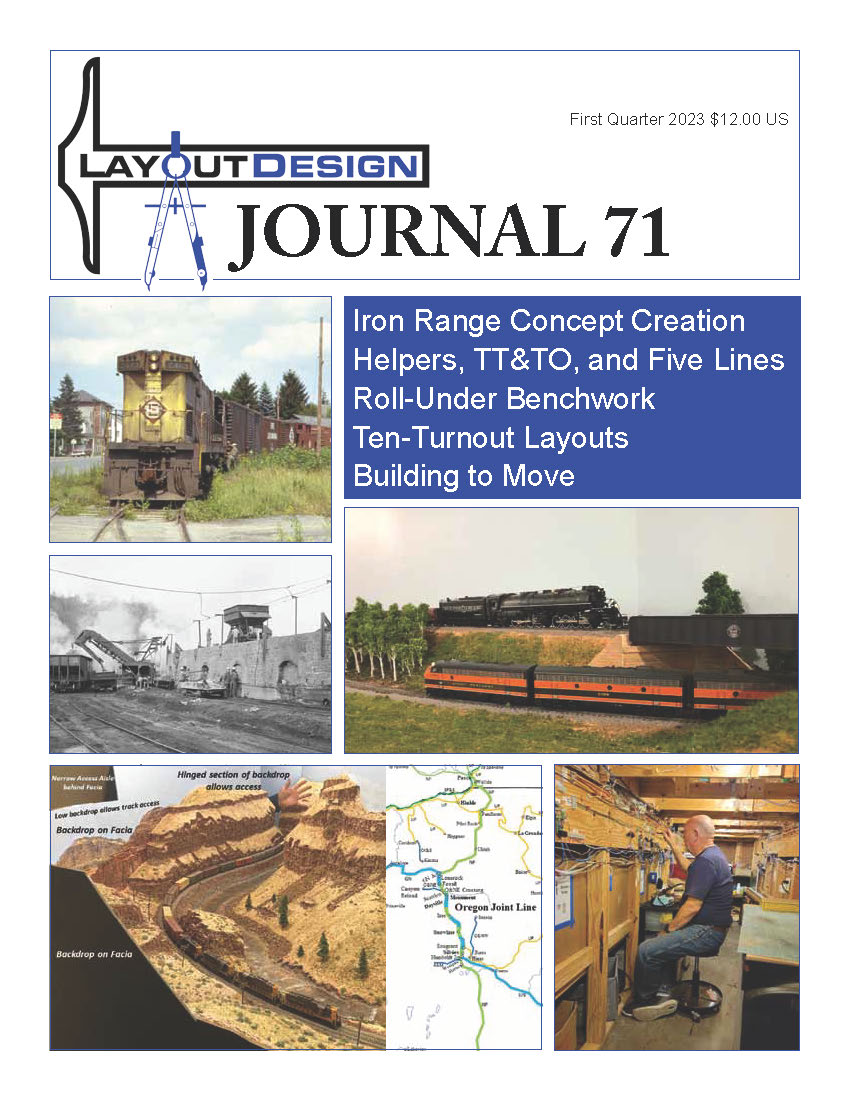
Layout Design Journal Issue #71 (First Quarter 2023):
Magazine Summary
This issue revolves around themes of adaptability, space-conscious planning, historical fidelity, and layout design for relocation or constrained settings. The articles in this edition highlight a growing emphasis on modularity, small-footprint realism, and operational authenticity, while continuing to explore diverse regions and railroad eras.
The feature article by Robert Hanmer examines concept development for a layout inspired by Minnesota’s Iron Range. Drawing from his earlier Hibbing-based plan, Hanmer expands the narrative to include Time Table and Train Order (TT&TO) operations, dual railroad staging, and era-specific freight and passenger traffic, culminating in a nuanced vision rooted in real-world geography and historical traffic flows.
Dean Ferris’s Oregon Joint Line in N scale demonstrates sophisticated proto-freelancing, blending imagined traffic routing and real-world inspirations. Emphasizing trackage rights, helper operations, and yard-to-yard transfers, Ferris effectively models intense operations across multiple railroads while incorporating staging, creative terrain modeling, and complex scheduling.
Jerry Hoverson presents an innovative benchwork solution with “roll-under” access, allowing a raised floor HO layout to remain maintainable even with physical limitations. His thoughtful construction techniques blend accessibility, strength, and visual neatness while maintaining a professional appearance.
The issue also features several 10-turnout layout Challenge designs, each emphasizing operational realism within a small footprint. Richard Turton’s Appalachian-themed design balances coal, coke and glass industry switching with dual-railroad interchange. Robert Stafford’s Pen Argyl branch showcases a standalone adaptation of a larger layout concept.
Eric Hansmann explores strategies for designing layouts intended to be relocated, while Robert Perry discusses single vs. double-track design tradeoffs.
Table of Contents
Articles
Iron Range Concept Development – Robert Hanmer – Page 4
Helpers, TT&TO, and Five Railroads – Dean Ferris – Page 8
Roll-Under Benchwork – Jerry Hoverson – Page 16
Appalachian Town in Ten Turnouts – Richard Turton – Page 21
Ten-Turnout Branch Terminus – Robert Stafford – Page 24
Building to Move – Eric Hansmann – Page 27
One or Two Tracks (or Both?) – Robert Perry – Page 32
Fascia Color Ideas from Display Layouts – Nicholas Kalis – Page 36
Columns / Departments
Ever Had One of Those … Years? – Byron Henderson – Page 3
Changes and Opportunities – Ron Burkhardt – Page 3
Meetings: NMRA DFW 2023 – Page 7
LDSIG Web Volunteers Needed – Page 15
Free Future Issues for Your Articles! – Page 37
Election, Report, and Call for Candidates – Pages 38–39
Detailed Article Summaries
Title: Iron Range Concept Development: Mines, Two Railroads, and TT&TO on the GN Mesabi Division Page 4
Author: Robert Hanmer
Railroads Modeled: Great Northern (GN); Duluth, Messabi & Iron Range (DM&IR) (Mesabi Division); concept applicable to all RR layouts
Location: Hibbing, Minnesota (previous layout); Gunn, MN; Grand Rapids, MN; Minnesota Iron Range
Era: 1958
Layout Scale: HO
Layout Size: Large room-sized layout
Techniques: Development of a concept; locale and era considerations; Prototype based design; Dual railroad operation, staging, TT&TO, mine runs, freight switching; passenger traffic, historical era modeling,
Summary:
Robert Hanmer describes the evolution of concept for his new Iron Range-themed layout based on shared trackage and operational complexity in northern Minnesota. Building upon a prior Hibbing, MN layout, the new design incorporates timetable and train order (TT&TO) operations, extensive mining operations, and multiple yards. It focuses on a 1958 operational era, chosen to capture a transitional time for steam, diesel, passenger, and ore traffic. Strategic use of GN and DM&IR shared trackage, freight and passenger variety, and industrial modeling creates an operationally rich and historically grounded layout concept.
Title: Helpers, TT&TO, and Five Railroads; Modeling Oregon’s “dry side” on the Oregon Joint Line Page 8
Author: Dean Ferris
Railroad Modeled: Proto-freelanced “Oregon Joint Line” (NP, GN, UP, SP, O&NE)
Location: Eastern Oregon
Era: late ‘60’s / early ‘70’s
Scale: N
Size: 25′ × 28′
Techniques: Multi-deck with no helix; nolix; shared trackage; trackage rights; helper ops; TT&TO; scenic compression; interchange; mid-run terminals; proto freelancing; lumber mills; stacked reversing staging loops; controlling sightlines; designing for photography;
Summary:
Dean Ferris’s Oregon Joint Line blends real and imagined railroads to create a prototypically plausible and visually spectacular layout. With intense mainline operations, helper service, and joint trackage among five competing railroads, the layout prioritizes yard operations, motive power variety, interchange transfers, and dispatcher complexity. The plan features mid-layout terminals, canyon scenes, a hinged backdrop for access, peninsulas eliminating a helix, and creative use of “blobs” to enhance realism in photography and train visibility. A strong focus on interaction and operator challenge—mirroring prototype railroad dynamics—makes this layout an operational standout in N scale, making use of its ability to provide wide open spaces.
Title: Roll-Under Benchwork: “People tunnels” ease wiring and maintenance Page 16
Author: Jerry Hoverson
Railroad Modeled: Rocky Mountain Central; (based on DRG&W); Colorado Pacific (based on RGS);
Location: Colorado
Era: Any
Scale: HO (standard and narrow gauge)
Size: Garage size 26 x 24’ with staging beneath main level
Techniques:
Elevated aisles, roll-under access, JMRI staging control, hard-surface skirts, modular framing, ergonomic access; elephant style loop staging; wye staging; ceiling hung valence
Summary:
Jerry Hoverson introduces a novel benchwork concept to enable seated roll-under access for simplified maintenance and wiring. Designed to accommodate physical needs post-surgery, the 10’ ceiling accommodates benchwork features raised aisles and elevated mainline heights, providing exceptional under layout accessibility, lighting, storage, and clean aesthetics. He describes construction of Valances, vertical wall supports, lift out access doors, and integrated power outlets, which enhance function and form. The layout supports complex dual-gauge operations, scenic visibility, and professional-grade construction within a manageable maintenance framework.
Title: Appalachian Town in Ten Turnouts: Two railroads serving natural-resource industries Page 21
Series: 10 Turnout Challenge introduced in LDJ-69
Author: Richard Turton
Railroad Modeled: Freelanced Appalachian town with B&O and WM elements
Location: Appalachia
Era: 1974
Scale: HO
Size: 10 x 15; reconfigurable U-shape
Techniques: Dual-railroad operations, raw material processing industry modeling, glass manufacturing; interchange, staging via cassettes, compact ops
Summary:
Richard Turton’s layout design challenge explores how to integrate multiple resource-processing industries and two railroads within a 10-turnout constraint. Set in the fictional Appalachian town of “Glassko,” the design supports coal, coke oven, sand, and glass operations with staged cassettes and realistic switching. Live Interchange between railroads and selective view blocks enhance visual appeal. The design offers compelling operations in a footprint suitable for small spaces, emphasizing realism without over-complexity.
Title: Ten-Turnout Branch Terminus: Portion of a larger design refined as a standalone layout Page 24
Series: 10 Turnout Challenge introduced in LDJ-69
Author: Robert Stafford
Railroads Modeled: Bangor & Portland; (DL&W); Freelanced based on Pen Argyl, PA
Location: Pen Argyl; eastern Pennsylvania
Era: 1974
Scale: HO
Size: 2′ × 9’6″ plus staging
Techniques: Slate industry, selective compression, closet layout, prototype-inspired end of branch line operations
Summary:
Robert Stafford presents a compact 10-turnout layout based on Pen Argyl, Pennsylvania, known for slate quarry operations. Though not an exact replica, the layout retains key commodities, switching complexity, and small-branch operations. Designed to fit in a closet, the plan supports interesting loads such as slate scrap, finished products, feed, and team-track deliveries. It illustrates how a portion of a larger layout can stand alone with engaging operations.
Title: Building to Move; Sectional benchwork to ease transport, preserve modeling Page 27
Author: Eric Hansmann
Railroads Modeled: Baltimore & Ohio; Varies (generalized advice)
Location: Wheeling, WV
Era: 1926
Scale: HO
Size: 10 x 16; adaptable to space; 2×4’ sections; Modular/portable
Techniques: Modular construction, relocation planning, detachment systems, lightweight scenery, simplicity of design and construction; sectional construction
Summary:
Eric Hansmann shares lessons from building a layout designed to be moved. The article covers track planning from ICC Valuation Maps, sectional benchwork, joinery techniques, detachable electrical connections, scenery strategies, and transport considerations. It’s a practical guide for those anticipating a future move, offering insight into preserving work without sacrificing quality or realism.
Title: One or Two Tracks (or Both?): Considering layout purpose, operating style, and more Page 32
Author: Robert Perry, O.D.
Railroad Modeled: Freelance Glacier Line (referenced example), general advice
Location: Any
Era: Any
Scale: O (example); general theory
Size: generally applicable
Techniques: Single vs. double-track theory; prototype-inspired design; operations-first vs display running planning; participation-focused layout design; train density; Concept/Theme development
Summary:
Robert Perry addresses a foundational layout design question: whether to model a single-track or double-track mainline. Drawing from both personal experience and prototype principles, he discusses the operational implications of each option. Perry advocates for an “operations-first” mindset—selecting mainline configuration based on desired operator participation and engagement, traffic patterns, and terrain constraints. He stresses the importance of meaningful interaction between trains and operators, whether through dispatcher communication, meets, bottlenecks, or maintenance-of-way (MOW) scenarios. The article incorporates design examples from the Glacier Line O-scale layout and emphasizes hybrid designs that strategically mix single and double-track sections to increase interest and realism. Perry’s commentary is especially valuable for designers weighing aesthetics against complexity and operational depth.
Title: Fascia Color Ideas from Display Layouts
Author: Nicholas Kalis
Railroad Modeled: Ian Clark’s Rockingham (UK P4 layout)
Scale: P4 (4mm:1ft, similar to OO)
Size: Exhibition display layout
Techniques: Visual design, fascia integration, exhibition modeling, color harmony
Summary:
Nicholas Kalis critiques common fascia color choices in American model railroads and offers insights from British exhibition layouts, particularly Ian Clark’s P4 Rockingham. He argues that U.S. layouts often default to green or black fascia colors that clash with the modeled scenery or remain unpainted, detracting from visual appeal. In contrast, the British layout features a putty-colored fascia that harmonizes with the scenery and enhances the viewing experience. Kalis encourages modelers to consider fascia color as part of the overall presentation, not an afterthought He offers aesthetic advice backed by photographic examples and suggests using muted or complementary tones based on the layout’s theme. The article closes by pointing readers to further resources in the LDSIG Layout Design Primer.
Download a free sample of pages from this issue.
To download the issue login to your member account: click “here“.
Non-members can join or renew: Click “here“