
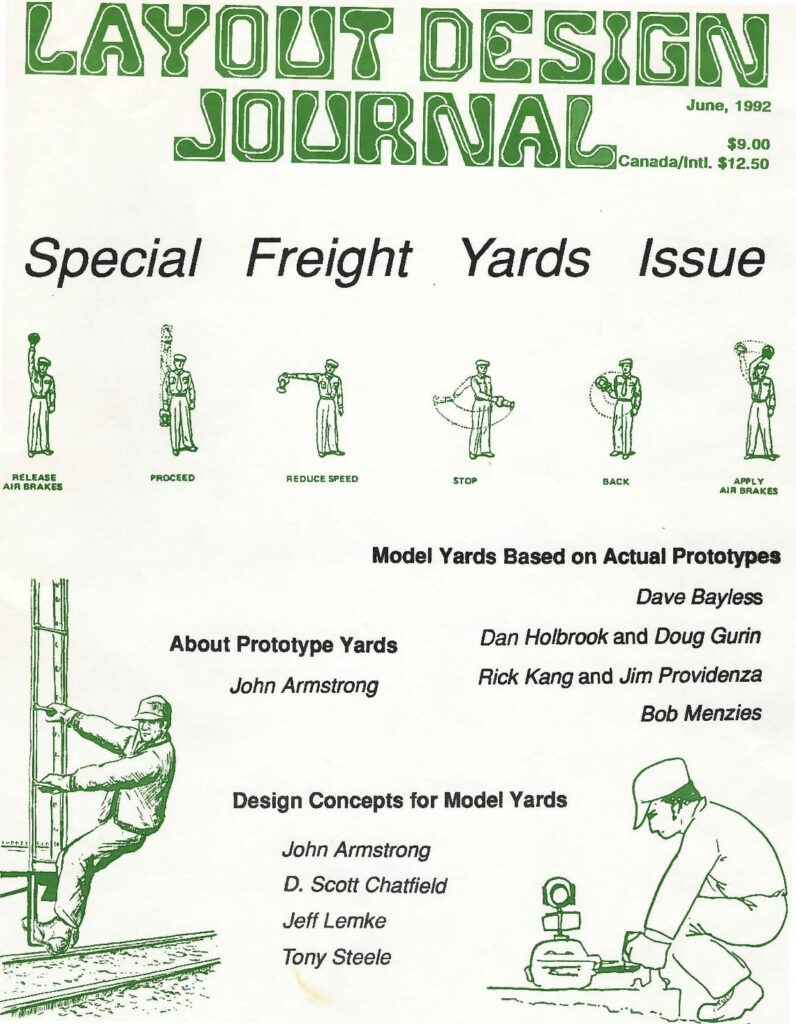
LDJ-7 JUNE 1992 (SPECIAL FREIGHT YARDS ISSUE, 80 Pages)
Magazine Summary
Layout Design Journal No. 7 marked a major transition in LDSIG publishing by introducing the long-form, single-topic format that would later become a defining characteristic of the journal. Rather than presenting a collection of unrelated articles, the issue focuses entirely on freight yard design and operation, examining the subject from prototype, model, operational, and design perspectives. The result is one of the most comprehensive treatments of railroad yards ever published for model railroaders.
The issue begins by establishing the importance of freight yards as central operating elements rather than simply collections of storage tracks. Doug Gurin argues that yards provide some of the highest densities of operational activity available on a layout and deserve significantly more design attention than they traditionally receive. The issue then builds a foundation through John Armstrong’s classic 1955 discussions of prototype yard functions and model yard design, supplemented by a 1992 epilogue reflecting changes in both railroading and the hobby.
A recurring theme throughout the issue is that yard design must be driven by function. Contributors repeatedly emphasize that the purpose of a yard determines its track arrangement, capacity requirements, classification methods, traffic flows, crew assignments, and operating procedures. The issue examines receiving yards, classification yards, departure yards, interchange yards, storage yards, and terminal facilities while explaining how each contributes to railroad operations.
Several articles present prototype-based case studies. The Burlington Northern’s 17th Street Yard in Superior, Wisconsin is analyzed from both operational and design perspectives, while the Delaware & Hudson’s “Bingo Yard” demonstrates how prototype facilities can be translated into effective model railroad operations. Additional articles explore crossover placement, yard throat geometry, train classification methods, and techniques for achieving operational realism.
Beyond track planning, the issue includes extensive discussion of paperwork systems, crew responsibilities, traffic management, train makeup, fast-clock considerations, and realistic yard procedures. Numerous diagrams, forms, maps, track plans, and prototype illustrations reinforce the text and transform the issue into a practical reference manual.
As an archival resource, LDJ-7 remains significant because it establishes many of the yard-design principles that continue to influence operations-oriented model railroad design. The issue serves as both an introduction to yard theory and a detailed technical reference for modelers seeking to understand how freight yards function and how those functions can be represented effectively on a layout.
Table of Contents
Articles
Benefits and Opportunities of Good Freight Yard Design — Doug Gurin — Page 6
Prototype Yards: How and Why — John Armstrong — Page 11
Simulating Yard Jobs at 17th Street — Dan Holbrook and Doug Gurin — Page 14
Yard Throat Design for Good Operation — Jeff Lemke — Page 23
The VN: A Design for Operational Reality — Rick Kang and Jim Providenza — Page 26
Five Rules of Yard Design — D. Scott Chatfield — Page 32
Designing Crossovers for Yard Operation — Dave Bayless — Page 33
Designing 17th Street Yard — Dan Holbrook and Doug Gurin — Page 38
Designing Model Railroad Yards — John Armstrong — Page 55
Yard Design: An Epilogue — John Armstrong — Page 66
Modeling “Bingo” Yard on the D&H — Bob Menzies — Page 71
News and Departments
The New Layout Design Journal — Michael Stimac — Page 3
Freight Yard Design: Our New In-Depth Style — Doug Gurin — Page 3
Detailed Article Summaries
LDJ-7
Title: Benefits and Opportunities of Good Freight Yard Design; Page 6
Author: Doug Gurin
Railroad Modeled: N/A
Location: N/A
Era: Multi-era
Layout Scale: Multi-scale
Layout Size: N/A
Techniques: Freight yard design; operations-first design; classification yards; yardmaster operations; traffic management; selective compression; operator density; railroad paperwork; fast-clock operation; layout operations; train makeup; switching operations; yard capacity planning
Article Summary:
Doug Gurin presents an argument for treating freight yards as primary operating elements rather than secondary layout features. He observes that many model railroaders devote considerable effort to mainline routing and industries while giving relatively little attention to the yards that organize railroad traffic. The article examines the advantages of freight yards from operational, scenic, and economic perspectives.
A central concept is operational density. Gurin notes that yards generate significantly more activity per square foot than most mainline trackage. Classification work, train assembly, switching, locomotive movements, and paperwork functions can keep multiple operators engaged continuously within a relatively compact area. This makes yards particularly attractive for layouts where space is limited.
The article also explores the aesthetic and display value of yards. Slowly moving trains, visible locomotive servicing, and concentrated rolling stock create opportunities to showcase equipment and railroad activity. Additional discussion covers crew assignments, paperwork systems, operating-session design, and the importance of using slower fast-clock ratios to avoid unrealistic pressure on yard crews.
Throughout the article, prototype operating practices are used to illustrate why freight yards remain central to railroad operations. The discussion establishes the conceptual foundation for the remainder of the issue by demonstrating that successful yard design combines operational realism, efficient space utilization, and thoughtful planning. The article serves as both a defense of freight-yard modeling and an introduction to the more technical discussions that follow.
Revised:
LDJ-7
Title: Prototype Yards: How and Why; Page 11
Author: John Armstrong
Series: Vintage John Armstrong (Reprinted from Model Railroader, June 1955)
Railroad Modeled: Prototype Railroads
Location: North America
Era: Prototype Railroad Practice
Layout Scale: N/A
Layout Size: N/A
Techniques: Prototype yard design; yard functions; classification yards; receiving yards; departure yards; interchange yards; yard terminology; railroad operations; train makeup; freight handling; yard geography; railroad planning; prototype research
Article Summary:
John Armstrong’s classic article examines the role of freight yards within the overall railroad transportation system. Rather than beginning with model railroad design, Armstrong first explains why yards exist and how they support efficient freight movement across a railroad network. He describes yards as essential links between local freight origins and destinations and the long-distance train movements that connect them.
The article defines yard terminology and explains the operational purpose of receiving tracks, classification tracks, departure tracks, storage tracks, interchange facilities, and specialized sub-yards. Armstrong emphasizes that each yard function influences track arrangement and operating practices. Numerous diagrams illustrate common yard components and terminology, providing readers with a vocabulary for understanding both prototype and model facilities.
Particular attention is given to yard location. Using prototype examples, Armstrong demonstrates why railroads place major yards at traffic concentration points, interchange locations, grade transitions, major population centers, and crew-change districts. He explains how traffic flows determine yard specialization and how railroads seek to concentrate classification work at selected terminals to improve efficiency.
The article serves as a foundational study of freight-yard operations. By focusing on prototype requirements rather than model railroad limitations, Armstrong establishes principles that can later be adapted to layout design. The discussion remains valuable because it connects track arrangements directly to railroad operating needs, a theme that recurs throughout the issue.
Revised:
LDJ-7
Title: Simulating Yard Jobs at 17th Street; Page 14
Author: Dan Holbrook and Doug Gurin
Railroad Modeled: Burlington Northern (BN)
Location: 17th Street Yard, Superior, Wisconsin
Era: Contemporary BN Operations
Layout Scale: N/A
Layout Size: N/A
Techniques: Yard operations; crew assignments; switchlists; yardmaster procedures; train classification; prototype operations; traffic management; railroad paperwork; operating-session design; freight car routing
Article Summary:
This article examines the operational practices used at Burlington Northern’s 17th Street Yard in Superior, Wisconsin, and explores methods for reproducing those activities during model railroad operating sessions. The focus is not on track planning but on the human and procedural aspects of yard operation.
Holbrook and Gurin analyze the responsibilities of yard crews, including classification work, train assembly, switching assignments, paperwork processing, and communication among operating personnel. Prototype forms, reports, switchlists, and train documentation are reproduced and discussed as tools for increasing realism.
A major theme is the importance of simulating decision-making rather than merely moving cars. Yard crews must prioritize tasks, manage track capacity, and balance competing operational requirements. The article demonstrates how realistic paperwork and procedural systems can create meaningful work for operators while reproducing prototype practices.
The discussion also addresses the relationship between layout design and operations. Efficient yard jobs require appropriate track arrangements, adequate capacity, and realistic traffic flows. By examining actual BN procedures, the article provides insight into how prototype railroads organize yard work and how model railroaders can adapt those methods to operating sessions.
Revised:
LDJ-7
Title: Yard Throat Design for Good Operation; Page 23
Author: Jeff Lemke
Railroad Modeled: N/A
Location: N/A
Era: Multi-era
Layout Scale: Multi-scale
Layout Size: N/A
Techniques: Yard throat design; turnout geometry; capacity planning; switching efficiency; crossover placement; yard operations; ladder design; track planning
Article Summary:
Jeff Lemke focuses on one of the most critical elements of freight-yard design: the yard throat. The article explains how throat arrangements influence yard capacity, switching efficiency, congestion, and operating flexibility.
Through diagrams and examples, Lemke evaluates alternative turnout arrangements and ladder configurations. Particular attention is paid to minimizing conflicting movements and maximizing access to classification tracks. The article demonstrates that seemingly minor changes in throat geometry can have major impacts on yard performance.
Operational considerations remain central throughout the discussion. Yard throats must accommodate switching movements, train arrivals, departures, and locomotive repositioning without creating unnecessary bottlenecks. The article emphasizes that designers should evaluate track arrangements based on expected traffic patterns rather than visual appearance alone.
By focusing on one specific component of yard design, Lemke provides practical guidance applicable to both prototype-inspired and freelance layouts.
Revised:
LDJ-7
Title: The VN: A Design for Operational Reality; Page 26
Author: Rick Kang and Jim Providenza
Railroad Modeled: VN Railroad
Location: N/A
Era: N/A
Layout Scale: N/A
Layout Size: N/A
Techniques: Operations-first design; freight-yard planning; traffic flow analysis; classification; prototype-inspired freelancing; operating realism
Article Summary:
Kang and Providenza present the VN as an example of a railroad designed around operational requirements rather than scenic display. The article explores how yard design, traffic flows, and train handling were integrated into the overall layout concept.
The authors emphasize realistic train classification, efficient movement of traffic, and the relationship between yards and the broader transportation system represented by the layout. Freight yards are treated as active transportation facilities rather than storage tracks, and operational decision-making is incorporated into the design process.
The article illustrates how prototype operating principles can guide the development of freelance railroads. By defining traffic patterns and operational goals before finalizing track arrangements, designers can create layouts that generate realistic operating challenges.
The VN serves as a case study demonstrating how operations-first planning influences every aspect of layout design, particularly freight-yard configuration and traffic management.
Revised:
LDJ-7
Title: Five Rules of Yard Design; Page 32
Author: D. Scott Chatfield
Railroad Modeled: N/A
Location: N/A
Era: Multi-era
Layout Scale: Multi-scale
Layout Size: N/A
Techniques: Yard design principles; classification yard planning; operational efficiency; capacity planning; traffic flow analysis; selective compression; switching design; yard functionality
Article Summary:
Scott Chatfield distills freight-yard planning into a concise set of fundamental design principles intended to improve both prototype fidelity and operating reliability. The article serves as a bridge between the broad theoretical discussions presented earlier in the issue and the detailed design examples that follow.
The five rules focus on functionality rather than appearance. Chatfield argues that successful yards must be designed around traffic requirements, expected train lengths, switching patterns, and operational objectives. He cautions against the common practice of simply fitting as many tracks as possible into available space without considering how the yard will actually function.
Particular emphasis is placed on capacity, accessibility, and flexibility. The article discusses the relationship between arrival tracks, classification tracks, departure tracks, and switching leads, demonstrating how imbalances among these elements can create operational bottlenecks. Chatfield also addresses the importance of designing for future traffic growth and changing operating requirements.
The article’s greatest value lies in its presentation of practical evaluation criteria. Rather than prescribing specific track arrangements, Chatfield provides a framework that designers can apply to a wide variety of prototype and freelance situations. The result is a concise but highly useful reference for assessing whether a yard design is likely to support realistic operation.
Revised:
LDJ-7
Title: Designing Crossovers for Yard Operation; Page 33
Author: Dave Bayless
Railroad Modeled: N/A
Location: N/A
Era: Multi-era
Layout Scale: Multi-scale
Layout Size: N/A
Techniques: Crossovers; yard geometry; switching efficiency; track planning; route flexibility; operational design; ladder design; turnout arrangement
Article Summary:
Dave Bayless examines the often-overlooked role of crossovers in freight-yard design and operation. While crossovers occupy relatively little space, they have a significant impact on switching efficiency, traffic flow, and the ability of crews to perform classification work without unnecessary delays.
The article evaluates crossover placement from an operational perspective rather than a purely geometric one. Bayless demonstrates how strategic crossover locations can reduce travel distances, improve access to classification tracks, and minimize conflicting movements between yard crews and arriving or departing trains.
Several examples illustrate the tradeoffs between additional flexibility and increased complexity. Excessive crossover installation can create maintenance issues and operational confusion, while insufficient crossovers may force inefficient switching patterns. The discussion focuses on identifying the locations where crossovers provide the greatest operational benefit.
Bayless emphasizes that crossover design should reflect the intended function of the yard. Receiving, classification, departure, and interchange tracks each impose different requirements, and crossover arrangements should be tailored accordingly. The article complements Jeff Lemke’s discussion of yard throats by showing how route flexibility influences overall yard performance.
Revised:
LDJ-7
Title: Designing 17th Street Yard; Page 38
Author: Dan Holbrook and Doug Gurin
Railroad Modeled: Burlington Northern (BN)
Location: Superior, Wisconsin
Era: Contemporary Burlington Northern Operations
Layout Scale: N/A
Layout Size: N/A
Techniques: Prototype yard analysis; yard classification; freight traffic generation; yardmaster operations; track planning; terminal design; train makeup; railroad paperwork; prototype documentation; yard capacity analysis
Article Summary:
Holbrook and Gurin present an in-depth analysis of Burlington Northern’s 17th Street Yard, examining both the physical design of the facility and the operational requirements that shaped its development. The article serves as one of the issue’s most detailed prototype case studies.
The authors analyze yard functions, traffic flows, classification requirements, and train handling procedures. Track arrangements are examined in relation to the jobs performed by yard crews, illustrating how prototype railroads organize infrastructure around operational needs. Yard leads, classification tracks, arrival and departure facilities, and support tracks are evaluated as parts of an integrated transportation system.
Maps, diagrams, and operational examples help explain how freight moves through the facility. The article demonstrates how traffic density, interchange requirements, and train scheduling influence yard design decisions. Special attention is given to the relationship between physical track arrangements and the procedural systems used by yard personnel.
For model railroaders, the article provides an excellent example of prototype-based design analysis. Rather than copying track plans directly, readers are encouraged to understand the reasons behind specific design features and then apply those lessons to their own layouts. The result is a valuable study of how prototype operations can inform model railroad planning.
Revised:
LDJ-7
Title: Designing Model Railroad Yards; Page 55
Author: John Armstrong
Series: Vintage John Armstrong (Reprinted from Model Railroader, June 1955)
Railroad Modeled: N/A
Location: N/A
Era: Multi-era
Layout Scale: Multi-scale
Layout Size: N/A
Techniques: Yard design; selective compression; classification yards; arrival-departure tracks; yard capacity planning; operational design; prototype adaptation; track planning methodology
Article Summary:
In the second of his classic 1955 articles, John Armstrong translates prototype yard principles into practical guidance for model railroad design. Building on the foundation established in “Prototype Yards: How and Why,” Armstrong focuses on adapting prototype functions to the physical limitations of model railroads.
The article explains how designers can determine the number of tracks required, establish yard capacity goals, and select appropriate levels of selective compression. Armstrong stresses that model yards must preserve operational functions even when physical dimensions are drastically reduced. The challenge is not reproducing every prototype track but reproducing the essential activities that occur within the facility.
Numerous diagrams illustrate alternative yard arrangements and show how track plans can be adapted to different spaces and operating objectives. Armstrong discusses receiving tracks, classification tracks, departure tracks, interchange functions, and locomotive servicing facilities while emphasizing the importance of maintaining logical traffic flow.
A recurring theme is balance. Yard capacity must match traffic volume, classification requirements must match train schedules, and track arrangements must support the intended operating scheme. Armstrong’s systematic approach provides a design methodology rather than a collection of fixed track plans.
The article remains one of the most influential discussions of yard design ever published for model railroaders and continues to serve as a reference for operations-oriented layout planning.
Revised:
LDJ-7
Title: Yard Design: An Epilogue; Page 66
Author: John Armstrong
Railroad Modeled: N/A
Location: N/A
Era: 1955–1992 Perspective
Layout Scale: Multi-scale
Layout Size: N/A
Techniques: Layout evolution; yard design theory; prototype changes; operating practices; freight transportation trends; yard modernization; design philosophy
Article Summary:
Written specifically for LDJ-7, Armstrong’s epilogue revisits the yard-design concepts originally published in 1955 and evaluates them in light of nearly four decades of changes in both railroading and model railroading. The article serves as a bridge between classic theory and contemporary practice.
Armstrong discusses how changes in railroad operations, traffic patterns, technology, and economics have affected yard design. He examines developments such as larger freight cars, longer trains, revised classification practices, and changes in the role of local freight service. These developments altered some design details while leaving many fundamental principles unchanged.
The article also reflects on changes within the hobby. Improved understanding of prototype operations, increased emphasis on realistic operating sessions, and advances in layout planning have expanded the ways model railroaders approach freight-yard design. Armstrong notes that many of the principles discussed in the original articles remain applicable because they are rooted in transportation requirements rather than specific technologies.
The epilogue provides historical context and reinforces the enduring value of understanding why yards function as they do. It serves as a thoughtful conclusion to the Armstrong material and highlights the continuing relevance of prototype-based design.
Revised:
LDJ-7
Title: Modeling “Bingo” Yard on the D&H; Page 71
Author: Bob Menzies
Railroad Modeled: Delaware & Hudson Railway (D&H)
Location: “Bingo” Yard
Era: N/A
Layout Scale: N/A
Layout Size: N/A
Techniques: Prototype modeling; yard compression; classification yard design; D&H operations; prototype research; track planning; yard operations; traffic flow analysis
Article Summary:
Bob Menzies presents a prototype-based study of the Delaware & Hudson’s “Bingo” Yard and explores methods for translating the facility into a model railroad environment. The article combines prototype research, operational analysis, and practical design considerations.
The discussion begins with an examination of the prototype yard’s purpose within the D&H system. Traffic patterns, classification responsibilities, train makeup requirements, and physical track arrangements are analyzed to identify the functions that must be preserved in a model version. Menzies emphasizes that understanding operations is more important than duplicating every track arrangement.
Selective compression plays a major role in the design process. The article explores techniques for reducing physical dimensions while maintaining operational capability. Track arrangements are evaluated according to their contribution to train handling, classification work, and traffic management.
The resulting design illustrates how a prototype yard can be adapted to model railroad space limitations without sacrificing operational realism. Menzies demonstrates that successful compression requires understanding which elements are essential and which can be simplified. The article serves as a practical example of the prototype-based design philosophy that appears repeatedly throughout the issue.
Revised:
To download the issue login to your member account: click “here“. Coming soon
Non-members can join or renew: Click “here“