
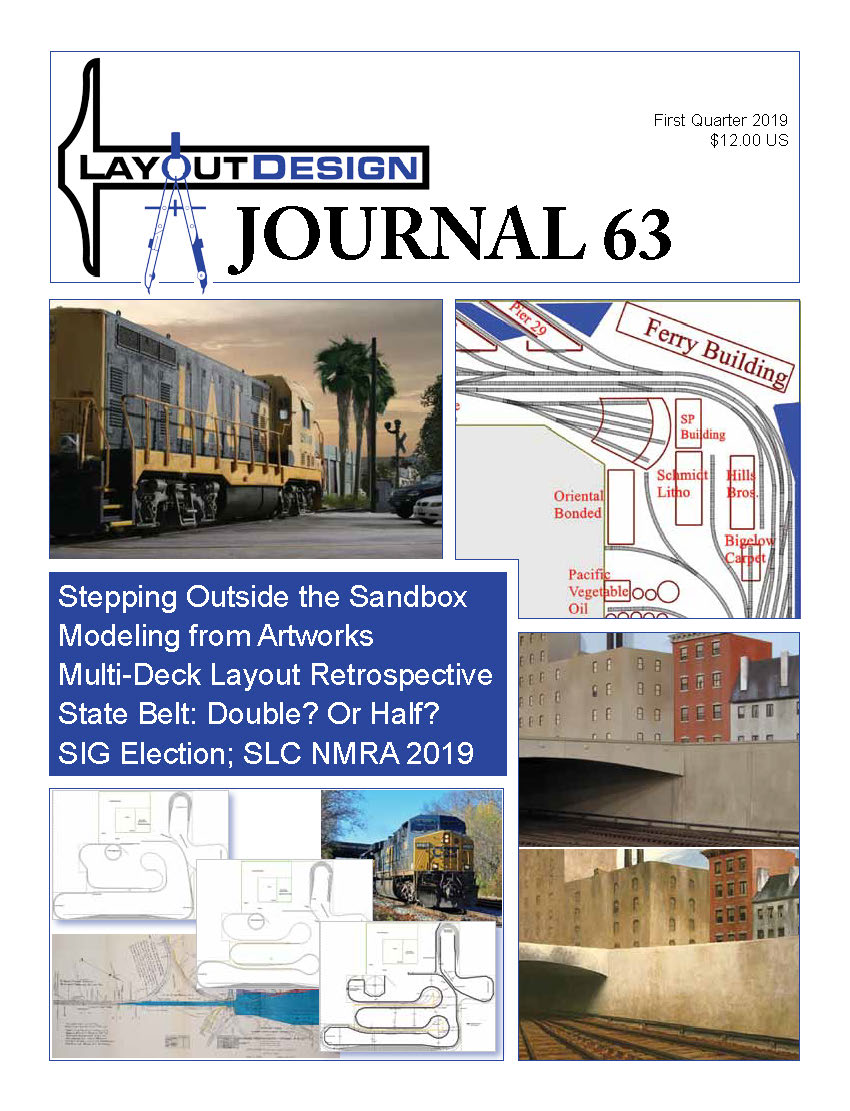
LDJ-63 FIRST QUARTER 2019 (FULL-COLOR, 40 PAGES)
1. Magazine Summary
This issue focuses on how model railroaders can improve layout design by incorporating artistic ideas, learning from past experience, and making thoughtful design decisions. The articles cover both visual and operational aspects of layout development.
Topics include applying artistic principles such as composition, color harmony, and visual storytelling to layout design, and using inspiration from artwork to create scenes that emphasize mood and atmosphere. One feature shows how the visual style of paintings can be translated into three-dimensional layout scenes, while other articles discuss techniques used in museum dioramas to improve focus, lighting, and presentation.
The issue also examines practical layout planning and redesign. One article looks at lessons learned from dismantling and rebuilding a large multi-deck layout, including improvements such as broader curves, longer mainline runs, better yard access, and revised staging arrangements. Another explores the challenges of modeling San Francisco’s State Belt Railroad and the tradeoffs between reproducing a prototype exactly versus selectively compressing it to fit available space.
Additional articles discuss using portable displays to communicate layout themes and provide context during public presentations. Overall, the issue highlights how design decisions, artistic influence, and experience can be combined to create layouts that are both visually effective and operationally sound.
2. Table of Contents
Articles
Stepping Outside the Sandbox – Lance Mindheim – Page 4
Modeling from Artworks – John Sethian (with additional text by Byron Henderson) – Page 6
Design Lessons Learned and Applied – Rick Lull – Page 17
Rethinking the State Belt: Double? Or Half? – Bill Kaufman – Page 24
Portable Banner to Set the Stage – Nicholas Kalis – Page 32
More Ideas from Museum Dioramas – Nicholas Kalis – Page 34
News and Departments
Different Perspectives – Byron Henderson – Page 3
Lots to Do – Ron Burkhardt – Page 3
Call for Board of Directors Candidates – Page 3
LDJ Comments – Jim Robertson; Burr Stewart — Page 19
New LDSIG Website – Bob Hanmer – Page 22
LDSIG Activities at Salt Lake City NMRA 2019 – Page 23
LDSIG Board of Directors Election – Page 35
3. Detailed Article Summaries
LDJ-63
Title: Stepping Outside the Sandbox; Leading designer and builder suggests new influences; Page 4
Author: Lance Mindheim
Railroad Modeled: N/A
Location: N/A
Era: N/A
Scale: N/A
Size: N/A
Techniques: Artistic composition; color theory; film analysis; cross-disciplinary modeling influences; modeling as art; mental approach to the hobby; visual arts; visiting art museums; classes on understanding art theory; military modeling techniques;
Article Summary: Broaden the horizons of model railroad design by engaging with disciplines outside the hobby—particularly the visual arts, film, and even military modeling. He contrasts the casual hobbyist with the deeply committed modeler and suggests that true mastery lies not in rivet counting but in developing artistic sensibilities such as color harmony, balance, and composition. By studying painting, film, and sculpture, model railroaders can elevate their layouts beyond technical accuracy into evocative works of art. He emphasizes immersion in art museums, reading biographies of great artists, and analyzing films for mood and composition. He also encourages learning from military modelers, who often demonstrate higher technical standards and creative innovation. The article calls on modelers to ‘rewire’ their thinking, positioning layout design as an art form that can inspire emotional engagement and transcend prototypical replication.
Revised: 2026-04-12
LDJ-63
Title: Modeling from Artworks; O Scale layout recreates scenes from paintings; Page 6
Author: John Sethian (with additional text by Byron Henderson)
Railroad Modeled: Freelance (with references to Edward Hopper)
Location: N/A
Era: N/A
Scale: O
Size: N/A
Techniques: Artistic scene replication; composition; perspective; lighting; shadows; mood setting; reproducing famous artworks as layout scenes; 3-D modeling a 2-D scene;
Article Summary: Practical application of incorporating fine art into layout design. Using Edward Hopper’s paintings such as ‘Approaching a City’ and ‘Second Story Sunlight,’ Sethian recreates their mood, lighting, and perspective within his O scale layout. This process involves not only replicating the visible portion of a painting but also expanding it into a complete three-dimensional environment. The challenge lies in translating Hopper’s manipulation of light and abstracted forms into a coherent scene that fits within a larger railroad context. He highlights how Hopper’s artistic liberties—ignoring strict geometry or perspective—can inspire layout builders to prioritize emotional impact over rigid realism. The result is a series of scenes that balance prototypical railroading with artistic storytelling, offering a unique blend of realism and mood.
Revised: 2026-04-12
LDJ-63
Title: Design Lessons Learned and Applied-Retrospective analysis informs new and better layout: Page 8
Author: Rick Lull
Railroad Modeled: Proto-freelanced Richmond Terminal Railroad; Richmond, Fredericksburg & Potomac (RF&P)
Location: Richmond, VA to Quantico, VA
Era: mid – 1990’s
Scale: HO
Size: Version 1: Basement; 33’x24’ triple deck; ; Version 2: ~Club; 1600 sq. ft. ; double deck
Techniques: Multi-deck planning; staging strategies; helix use; CAD planning; operational focus; yard design; Centralized Traffic Control (CTC) based; blobs, LDSIG layout design consultation; designing your house for a layout; footprint variations; value of prior layout tours and operation; negotiating with building contractor; yard placement near staging lengthens main line run; aisle design for operating crews; operate early; JMRI signal system; deck spacing; yard track spacing; prototype fidelity vs model layout operations; importance of accurate room plan; iterative design process; geographic orientation; stacking loops;
Article Summary: Rick Lull provides an in-depth retrospective on his Richmond Terminal Railroad, reflecting on Version 1’s strengths and weaknesses while describing the evolution toward Version 2. Version 1, a three-deck design with staging and a large yard, revealed shortcomings such as steep grades, tight radii, aisle congestion, and limited mainline runs. Through operating sessions, Rick and his crew identified improvements such as wider aisles, better yard access, more realistic staging, and improved track spacing. Version 2 , a large HO basement-filling railroad, incorporates lessons learned: stacked helixes, longer runs, broader curves, and refined signaling and staging. He emphasizes the importance of CAD design tools, consultation with peers, and iterative planning to balance prototype fidelity with operational goals. The article captures the compromises inherent in large-scale layout design and the necessity of adapting to real-world constraints.
Revised 2026-04-12
LDJ-63
Title: Rethinking the State Belt; Double? Or Half?: Alternatives in different spaces; Page 24
Author: Bill Kaufman
Railroad Modeled: State Belt Railroad (San Francisco)
Location: San Francisco, CAEra: WWII
Scale: HO
Size: Spare Room; 12’ x 12’; plus outside aisles; and proposed Garage; ; 17’ x 17’; plus outside aisles
Techniques: Selective compression; prototype analysis; operational focus; car floats; story telling; interchange; feature selection; street running; history of State Belt Railroad; rail-marine; cassette staging; foam blocks to prevent movement on portable car floats; float alignment pins; printed Bay Bridge backdrop
Article Summary: Should the existing layout be modeled at full length (‘double’) or in a compressed form that still conveys its essential operational flavor (‘half’) depending on the available space. There are trade-offs in either approach: the fidelity and operational possibilities of modeling the full prototype versus the spatial economy and adaptability of compression. The State Belt’s distinctive role as a short line interfacing with major Class I railroads and serving signature waterfront industries and the military base at the Presidio is highlighted. Analysis provides readers with a structured way to think about compression, realism, and achievable goals within their own layouts.
Revised: 2026-04-12
LDJ-63
Title: Portable Banner to Set the Stage: Borrowing British exhibition layout idea for home and road; Page 32
Author: Nicholas Kalis
Railroad Modeled: Oahu Sugar Company
Location: Waipahu, HI
Era: 1944
Scale: N/A
Size: N/A
Techniques: Public presentation; thematic storytelling; visual branding; creating a display banner; roll up / retractable displays; visitor orientation to layout theme;
Article Summary: To enhance the storytelling aspect of a large-scale Hawaiian layout, a portable banner is created. The banner visually introduces the layout’s theme and context to viewers at exhibitions or at the entry to a home layout, helping to orient and engage the audience. This article emphasizes the importance of visual communication and narrative in public model railroad presentations, showing how supplemental materials can extend the immersive experience beyond the layout itself.
Revised: 2026-04-12
LDJ-63
Title: More Ideas from Museum Dioramas; Page 34
Author: Nicholas Kalis
Railroad Modeled: N/A
Location: N/A
Era: N/A
Scale: N/A
Size: N/A
Techniques: Diorama techniques; visual focus; lighting; storytelling; scene composition; slope down toward backdrop; slope up toward backdrop; forced perspective
Article Summary: Building on his earlier writings, Nicholas Kalis draws parallels between museum dioramas and model railroad layouts. He notes that museums excel at focusing attention, controlling lighting, and structuring scenes to tell stories effectively. Modelers can adopt these same techniques to improve immersion and narrative clarity. Readers are encouraged to think beyond mechanical fidelity and instead focus on how visitors experience a scene: what is highlighted, what is obscured, and how lighting shapes mood. The article offers practical insights into how diorama methods can enrich layout presentation and enhance storytelling.
Revised: 2026-04-12
Download a free sample of pages from this issue.
To download the issue login to your member account: click “here“.
Non-members can join or renew: Click “here“