
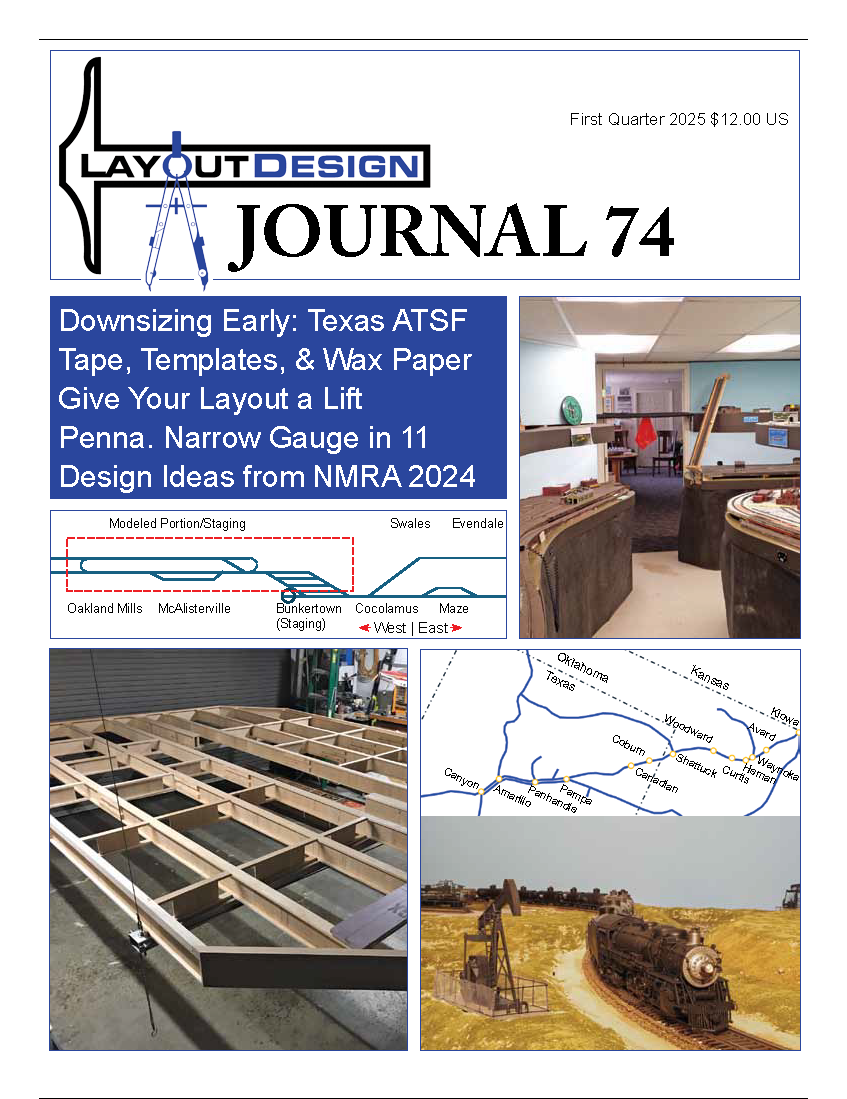
The Layout Design Journal (LDJ), Issue 74 (First Quarter 2025)
Issue #74 of the Layout Design Journal explores a range of thoughtful, experience-informed approaches to layout design, with particular emphasis on realistic planning, downsizing for age and practicality, operations-focused layouts, and creative construction techniques. The overarching themes center around adapting model railroading to fit personal constraints—whether due to aging, space limitations, or time management—while maintaining operational interest and prototype-inspired realism.
This issue opens with Tim Fisher’s feature on downsizing a Santa Fe-themed layout in Texas, emphasizing early planning for retirement-friendly spaces while retaining full operational functionality. His evolution through multiple layouts culminates in a focused, high-capacity design built within a condo basement, illustrating the merits of single-town modeling and staging integration. Bill Dye contributes an insightful piece on planning a multi-deck N scale proto-freelanced layout inspired by Pittsburgh and its industrial heritage. His detailed, step-by-step account covers everything from operations planning to layout construction using tape, templates, and wax paper.
Ray DeWeese tackles the challenge of building a layout in a shared garage by implementing an innovative lift-up benchwork system, allowing for a medium-sized HO layout to coexist with daily life. John Brett presents a Pennsylvania narrow gauge layout in On30 within an 11′ x 11′ room, showcasing highly compressed yet compelling industrial switching drawn from East Broad Top inspiration. Finally, Byron Henderson reports from the 2024 NMRA National Convention in Long Beach, highlighting recent layout design trends, including modular approaches, urban switching interest, and advances in digital planning tools.
Layout scales in this issue range from HO to On30 to N, and modeling strategies include CAD planning, multi-deck construction, hand-laid track, vertical lift mechanisms, and ops-driven design. Collectively, these articles reflect a strong trend toward practical, purpose-built railroads that maximize enjoyment, minimize maintenance, and prioritize realistic operations in available space.
Table of Contents
Articles Downsizing Early: Texas ATSF – Tim Fisher – Page 4
Earlier Themes and Layouts – Tim Fisher – Page 10
Tape, Templates, and Wax Paper – Bill Dye – Page 17
Give Your Layout a Lift – Ray DeWeese – Page 29
Pennsylvania Narrow Gauge in 11 – John Brett – Page 32
Layout Ideas from Long Beach NMRA 2024 – Byron Henderson – Page 36
Columns and Departments Not That Realism! – Byron Henderson – Page 3
Winter Work – Ron Burkhardt – Page 3
LDSIG Board of Directors Reports & AGM – Various – Page 38
Meetings: San Luis Obispo, CA; Novi, MI – Various – Page 39
Detailed Article Summaries
Downsizing Early: Texas ATSF; Cimarron & Santa Fe in HO: Downsizing Early with a Do-able Scope Page 4
Author: Tim Fisher
Railroad Modeled: Cimarron & Santa Fe; Atchison, Topeka & Santa Fe (Plains Division) with a map of the territory modeled
Location: Pampa, TX;
Era: 1945
Layout Scale: HO
Layout Size: 28’ x 34’ basement condo layout
Techniques: Single-town design, staging loop, Double-ended staging, L-girder benchwork, aluminum backdrops, CAD-inspired planning, DCC operations, manageable scope, obstructions, out and back, rapid construction methods, downsizing scope to accelerate progress,
Fisher’s Cimarron & Santa Fe replicates Pampa, Texas, in 1945, with operations based around oil industries, carbon black plants, and Santa Fe’s wartime traffic. The theme emphasizes one town and one staging yard, enabling both passenger and freight operations. Large steam locomotives such as 2-10-4s and 4-8-4s run alongside mixed trains and locals. Fisher explains his iterative planning process—from selecting a locale and objectives, starting from two-blob staging concepts, adapting published plans, and refining through construction with four iterations of his plan, and getting help from experienced layout designers. He highlights the advantages of early downsizing, allowing 1,000 hours of work to yield an operational layout within 17 months. Special features include engine pockets in staging, a wye for flexibility connection to a branch line, and focus on reducing duckunders. The narrative demonstrates how careful planning aligned with realistic expectations can create a highly operable railroad.
Along the Way…Earlier Themes and Layouts Page 10
Author: Tim Fisher
Railroad Modeled: Santa Fe (multiple locations: Curtis Hill, Amarillo, Plains Division)
Location: Amarillo, TX; Waynoka, TX; Curtis Hill, TX
Era: 1944-1949Scale: HO (early attempts in N)
Layout Size: Varied from 12’ x 24’ sectional to 38’ x 26’ basements
Techniques: Loop-to-loop mainlines, helper operations, visible staging yards, aluminum backdrops, conversion to DCC, signaling systems, rolling stock selection, prototype documentation, turnout motor mounting
This retrospective recounts Fisher’s 50-year evolution as a layout builder, beginning with an ambitious but unwieldy oval plan and progressing through progressively refined prototype-based layouts. His Curtis Hill plan incorporated helper operations, while Amarillo’s version emphasized industrial operations and staging capacity. Lessons included avoiding duckunders, understanding locomotive limits, and the importance of aligning scope with available time. Fisher also reflects on technological changes—from brass steam to DCC sound—and on the shift in hobbyist focus from steam-diesel transition modeling to modern intermodal and unit trains. The article shows both personal growth in the hobby and a broader commentary on the hobby’s changes.
Tape, Templates, and Wax Paper; Multideck Proto-Freelance Pittsburgh B&O Planned for Operations Page 17
Author: Bill Dye
Railroad Modeled: Proto-freelance ‘Pittsburgh, Cleveland, and Monongahela’ (B&O and P&LE inspired)
Location: Pittsburgh, Glenwood, McKeesport, Herr’s Island, North Side Branch, Butler, Mars, Punxsutawney, PA; Youngstown, OH.
Era: 1954 ish
Layout Scale: N
Layout Size: 31’ x 18’ L-shaped basement, multi-deck
Techniques: Givens and Druthers, Multi-deck with helix, tape-and-template track location planning, wax paper yard throat design, staging integration, factory footprint mockups, industry selection, proto-freelancing, deck height selection, laser level, layout depth, car weighting, phone inclinometer, helix construction, staging yard track separation, Fast Tracks turnout construction and tuning, slide switches for powering frogs
Bill Dye describes his proto-freelance Pittsburgh-area railroad designed for operations including a route map. The lower deck emphasizes urban industries such as Heinz pickle and processing plants, Herr’s Island stockyards, and Glenwood Yard, while the upper deck handles long-distance mainline traffic. Dye’s hallmark techniques include laying black electrical tape for iterative track arrangements, using Fast Tracks turnout templates, and designing Glenwood Yard with wax paper to test ladder arrangements, body track lengths, and track spacing. Construction innovations include a two-track, 48” diameter helix with a gentle 1.2% grade with a steeper 1.4% prior to entry into the helix, and staging yards located outside the main room. The Heinz plant serves as a signature industry, with compressed but imposing footprints that provide realistic switching complexity.
Give Your Layout a Lift: Classic HO Layout Lifts to share Garage with a Car Page 29
Author: Ray DeWeese
Railroad Modeled: Freelance
Layout Scale: HO
Layout Size: 11 x 15’ Garage layout with motorized lift
Techniques: Liftable benchwork, ceiling reinforcement, shared garage use, mechanical design, engineered I-beam table, leveraging modern construction methods,
DeWeese tackles the challenge of modeling in a shared garage by designing a 90 volt DC motorized lift system that raises the entire layout above parked vehicles. His article discusses engineering challenges such as load distribution, ceiling reinforcement, and alignment reliability. He details construction of the platform with balsa and basswood I-beams. The central access and platform nest into an extruded foam valance ’lid’ for dust protection. Drawings of the table and adjustable lifting cable and pulley mechanism are provided. The piece serves as a case study in creative benchwork and space adaptation.
Pennsylvania Narrow Gauge in 10 11: Freelanced Railroad Goes “Beyond the Basement” Page 32
Author: John Brett
Railroad Modeled: Juniata County Railroad; Freelance Pennsylvania narrow gauge
Location: Port Trevorton, PA, Mifflintown, PA; McAlisterville, PA; Juniata County
Era: early 20th century
Layout Scale: HOn3
Layout Size: 16 ‘x 3’4”, compact sectional layout
Techniques: Selective compression, small layout design, sector plate staging, Single-town design, reversing connection, historical plausibility
This layout design is the latest in response to the ‘Layout in 10 Turnouts Challenge’ posed in LDJ-70, however, using 11 turnouts. Brett presents HOn3 layout representing Pennsylvania narrow-gauge practice. Despite its small size, the plan incorporates staging, scenic variety, and operational possibilities with simple card systems. The article stresses selective compression and careful scenic design to capture the atmosphere of narrow-gauge operations. It demonstrates that meaningful, operable railroads can be built even in very limited spaces.
Layout Ideas from Long Beach NMRA 2024
Authors: Donn Winn, Lloyd Lehrer, Barbara Soward, Ron Varnell
Railroad Modeled: Various
Layout Scale: Multiple
Layout Size: Range from shelf layouts to large modular clubs
Techniques: Modular construction, creative staging, freelance concepts
This section compiles design inspirations from the NMRA 2024 convention in Long Beach. It captures sketches, modular designs, and innovative staging methods presented in clinics and displays. The feature functions as a photo gallery of ideas rather than full case studies, providing readers with a toolkit of approaches to adapt into their own projects. Subjects include a nolix grade on a peninsula, double-deck lift gate, and geodesic foam molds.
Download a free sample of pages from this issue.
To download the issue login to your member account: click “here“.
Non-members can join or renew: Click “here“