
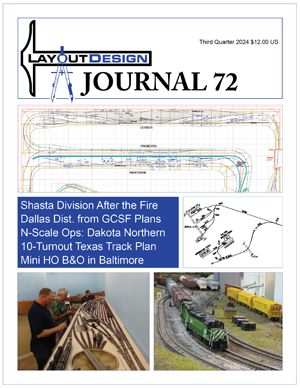
LDJ-72 THIRD QUARTER 2024 (FULL-COLOR, 40 PAGES)
LDJ-72. Magazine Summary
This issue is anchored by the central feature on Gary Ray’s Shasta Division Gerber Subdivision,. This article explores themes of layout evolution, resilience, prototypical fidelity, and strategic compression, highlighting the intersection between personal experience and thoughtful design methodology.
The overarching narrative of this article is shaped by Ray’s reconstruction journey following the devastating Camp Fire that came close to his Paradise, CA layout. His three-decade progression across multiple layouts demonstrates lessons learned in staging, operations design, multi-deck planning, and prototype railroad operations. Emphasis is placed on switching-intensive towns in the Central Valley versus helper service for mountain railroading.
Complementing this are four other notable articles: James Peterson’s Minimal Compression, Busy Ops showcases a Dallas-based layout with focused operational density; Olaf Melhouse’s Proto-freelance Prairie Shortline reflects decades of protolanced practice in N scale; Travers Stavac’s compact B&O layout emphasizes compression of space and urban density in Baltimore; and Don Vail’s 10-Turnout Texas Tangle offers an example of operational richness within a tight footprint using only ten turnouts.
Trends across the issue include renewed focus on realistic operations, use of CAD for planning, staging innovation, and different era modeling. Readers will find a balance of high-level conceptual guidance and practical execution strategies. The issue also underscores the LDSIG’s commitment to community connection through online seminars and continued publication improvements.
Table of Contents
Articles
Shasta Div. Gerber Sub. After the Fire – Gary Ray – Page 4
Minimal Compression, Busy Ops – James Peterson – Page 22
Proto-freelance Prairie Shortline – Olaf Melhouse – Page 27
B&O’s Sparrows Point Branch in 10 – Travers Stavac – Page 30
10-Turnout Texas Tangle – Don Vail – Page 35
News and Departments
I Had Something Else Planned – Byron Henderson – Page 3
Journal, News, Online, In-person – Ron Burkhardt – Page 3
Call for Board of Directors Candidates – Page 21
Meetings: NMRA Long Beach Aug. 2024 – Page 21
LDSIG Web Volunteers Needed – Page 21
Free Future LDJ Issues for Your Articles! – Page 39
Detailed Article Summaries
LDJ-72
Title: Shasta Div. Gerber Sub. After the Fire: 1926 SP railroading from dream to reality in three layouts Page 4
Author: Gary Ray
Railroad Modeled: Southern Pacific, Shasta Division – Gerber Subdivision,
Location: Dunsmuir to Weed, CA (prior CA layout) – Gerber to Redding, California (new TX layout)
Era: 1926
Layout Scale: HO
Layout Size: Originally 24’×60′ multi-deck (CA); currently 25’×44′ single deck (TX)
Techniques: Mushroom design; mushroom construction; multi-deck spiral climb; helper operation; nolix; hand laid track; CADrail and 3rd Planit software; staging yards; switching-focused -operations, LDEs, JMRI switchlists, Fast Clocks, TT&TO, prototypical research; access pit to avoid duckunders; mountain railroading
Article Summary:
Gary Ray documents a deeply personal and technically rich journey through three iterations of a layout based on the Southern Pacific’s Shasta Division. Beginning with an ambitious 4-deck mushroom design in a California garage, he transitioned to a more refined two-deck layout in a purpose-built building in Paradise, CA. The aftermath of the Camp Fire of 2018, prompted relocation to Texas where a new single-deck version was born. The article chronicles how Gary’s operational philosophy evolved through operating sessions on others’ layouts—from Siskiyou mountain railroading to switching-intensive valley towns—and how extensive prototype research, operations with JMRI, and design tools like CADrail and 3rd PlanIt informed each layout’s development, with track plans of each. The narrative captures lessons learned in helix geometry, aisle width, lighting, early operation, and refinement of prior Givens & Druthers in the latest iteration.
LDJ-72
Title: Minimal Compression, Busy Ops: The Gulf, Colorado& Santa Fe, Dallas District Page 22
Author: James Peterson
Railroad Modeled: Acheson, Topeka & Santa Fe (ATSF)
Location: Dallas, TX Area; Gainesville to Cleburne, TX
Era: 1960
Layout Scale: HO
Layout Size: 25 x 38’ plus staging yards in hallway
Techniques: Prototype planning, selective compression, industry switching, LDE-based planning, operations-focused design; high traffic density; foldable turning loops in staging; raised floor height; aisle design; electric uncoupling magnet control.
Article Summary:
Peterson explores how to create intense operational activity within a limited footprint by focusing on a small section of the Santa Fe Railroad in the Dallas, TX area. Using minimal compression, the layout plan includes a dense concentration of industries served by a yard and urban trackage. He discusses his methodology for narrowing prototype focus, selecting only a few miles of trackage, and replicating it with care. The layout includes features such as visible staging and carefully planned switch ladders to allow varied and prototypical operations in a compressed space.. An explanation of crew job assignments is described.
LDJ-72
Title: Proto-freelance Prairie Shortline: The Dakota Northern is N Scale railroading at its best Page 27
Author: Olaf Melhouse
Railroad Modeled: Dakota Northern; Freelanced prairie shortline based on the Great Northern (GN)
Location: Grand Forks; Devils Lake, Minot, North Dakota
Era: 1970’s
Layout Scale: N
Layout Size: 12 x 20’Techniques: Midwest agriculture-based railroading; long-term operations, detailed scenery, freelance with prototype influence
Article Summary:
Olaf Melhouse shares insights from a 25-year journey with his N scale prairie shortline layout. While not strictly prototypical, the layout takes cues from real railroads and adapts them into a cohesive and believable design. The article touches on crew assignments and maintaining long-term interest through regular operating sessions. In addition to seven grain elevators, the layout features fertilizer plants, farm equipment dealers, bulk oil facilities, a rock quarry, a cement plant, and a coal-burning power plant
LDJ-72
Title: B&O’s Sparrows Point Branch in 10: How to Eat an Elephant? Take Small Bites Page 30
Series: Ten Turnout Challenge introduced in LDJ-69
Author: Travers Stavac
Railroad Modeled: Baltimore & Ohio – Sparrows Point Branch
Location: Baltimore, MD
Era: 1952
Layout Scale: HO
Layout Size: 10 x 6.5’ L-shaped shelf
Techniques: Small-footprint planning; urban switching, B&O prototype research,;; modeling urban traffic; Concept development; terminal operations; ‘Works like ‘vs ‘Looks like’ scenes; compressive selection; sector plate; industry specific car spots
Article Summary:
A condensed urban switching layout based on the B&O’s Sparrows Point Branch in Baltimore. The design replicates key industrial customers and infrastructure using just ten turnouts. Stavac demonstrates how sector plates, thoughtful backdrop use, and compressive selection allow him to evoke the gritty industrial character of the area. The design supports complex switching moves and includes operational features like auto plant, large urban industry, and steel mill traffic. This article provides inspiration for those seeking high-density ops within a limited room or shelf environment.
LDJ-72
Title: 10-Turnout Texas Tangle: Lampasas on the ATSF in 1984 with a prototype switchback Page 35
Series: Ten Turnout Challenge introduced in LDJ-69
Author: Don Vail
Railroad Modeled: Atchison, Topeka & Santa Fe (ATSF)
Location: Lampasas, TX
Era: 1984
Layout Scale: N
Layout Size: 11.5 x 9.5’
Techniques: CLIC diagrams; industrial switching; schematic-based planning; prototype based operations
Article Summary:
Don Vail challenges conventional design norms by developing an entire operating layout within the ten turnouts structure of the Design Challenge. The freelanced Texas-themed layout emphasizes operational interest through emulating branch and switchback tracks, industry placement, and crew coordination. He incorporates a runaround located away from the industrial area, continuous running, and a two-track fiddle yard. Vail provides prototype CLIC track diagrams and operational scenarios demonstrating how even minimal infrastructure can provide variety and interest. The article encourages readers to think creatively about operational design and resource limitations, making it ideal for apartment dwellers, beginners, or anyone seeking a compact challenge.r apartment dwellers, beginners, or anyone seeking a compact challenge.
Download a free sample of pages from this issue.
To download the issue login to your member account: click “here“.
Non-members can join or renew: Click “here“