
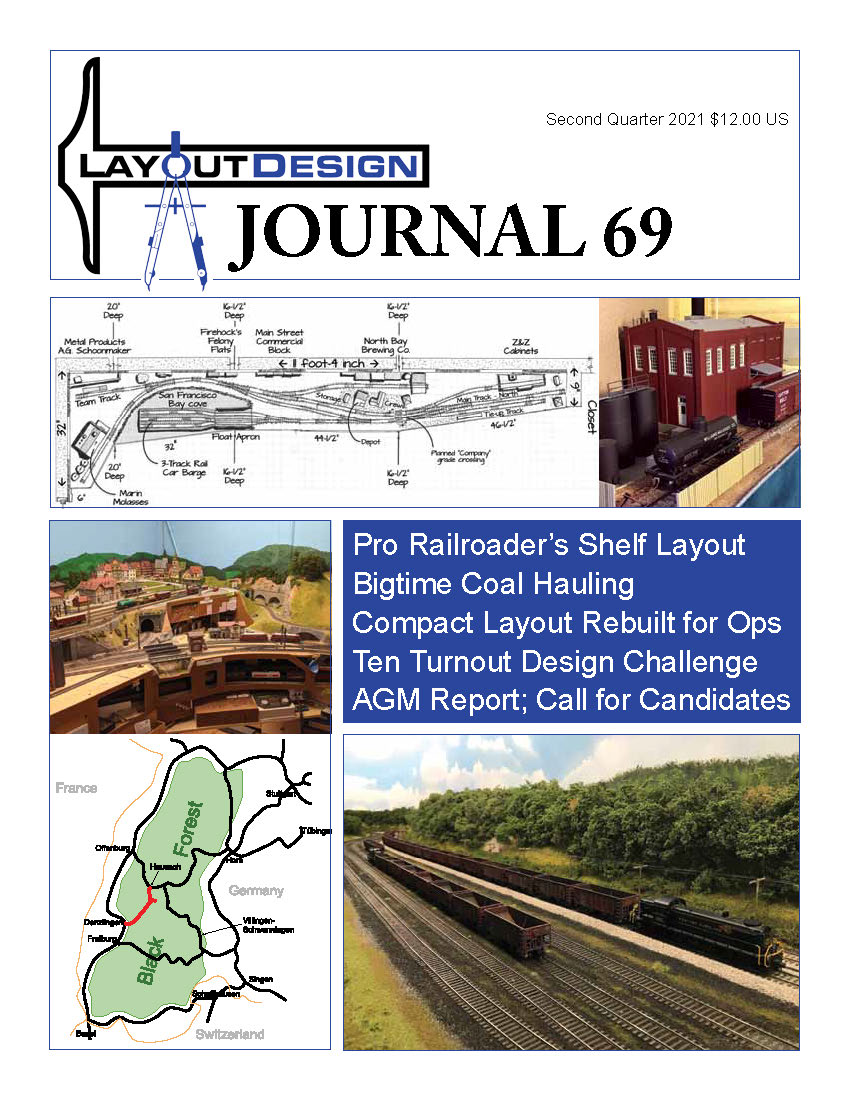
LDJ-69 SECOND QUARTER 2021 (FULL-COLOR, 40 PAGES)
Magazine Summary
The themes include small layout optimization, coal-hauling operations, rail-marine terminals, and the creative reuse of limited or awkward spaces for compelling layout design.
Leading the issue is Steve “Breezy” Gust’s feature on his Marin Sub, a rail-marine terminal based on the Northwestern Pacific’s Tiburon and Sausalito operations. Gust blends historical research, alternative history, and personal experiences to develop a believable and engaging switching shelf layout in a modest home office space. His article highlights efficient track planning around a car barge, low turnout count, and prototypical operating procedures, emphasizing design constraints like reach, visual mass, and operational logic.
Richard Turton’s expansive coal-hauling layout captures the scope of the Western Maryland’s Fairmont Lines, focusing on the Chiefton yard and Ida May mine. The article is a masterclass in modeling prototype operations at scale, integrating staging, coal classification, and operational realism within well-researched Layout Design Elements (LDEs). Turton’s layout also addresses modern challenges like ergonomics, layout lighting, and signature structure replication. It also discusses future expansion plans.
Bernhard Beck’s compact German-themed layout shows how to transform “found” spaces—like a corner of a garage—into fully operational environments. Using a shallow footprint design, Beck demonstrates adaptability and space-conscious design paired with European modeling aesthetics.
Rounding out the issue is the Ten Turnout (or Fewer!) Design Challenge, encouraging creative constraint and efficient design across scales and themes.
Table of Contents
Articles
Pro Railroader’s Rail-Marine Shelf Layout – Steve “Breezy” Gust – Page 4
Bigtime Coal-Hauling in HO – Richard Turton – Page 12
Rebuilding for Ops in a Compact “Found” Space – Bernhard Beck – Page 28
Ten Turnout (or Fewer!) Design Challenge – Byron Henderson – Page 37
Columns / Departments
Well, That was Unexpected – Byron Henderson, LDJ Editor – Page 3
Positive Changes – Ron Burkhardt , LDSIG President– Page 3
Board of Directors Call for Candidates – Page 3
LDSIG 2020 Annual General Meeting Minutes – Page 36
Updating the LDSIG Primer – You Can Help! – Page 38
LDSIG 2020 Board Election Results – Page 39
Detailed Article Summaries
LDJ-69
Title: Pro Railroader’s Rail-Marine Shelf Layout: The Northwestern Pacific inspires compact switching layout; Page 4
Author: Steve “Breezy” Gust
Railroad Modeled: Clay & Mud Point Railroad (freelanced from Northwestern Pacific; (NWP))
Location: Sausalito, Tiberon, CA
Era: September 1970
Layout Scale: HO
Layout Size: Shelf; 11’4″ × 2’8″; shelf layout in home office
Techniques: Rail-marine terminal; limited turnouts; car barge ops; idler cars; barge service vs rail marine terminal vs car float; alternative history; KISS design,; structure flats vs background buildings; operations-focused design; 1:1 mock-ups; end of line terminal; shelf layout; limited reach; prototype operating rules; union rules; concept development; structure size development; suggested compression through usage of background buildings; structure size development; sequencing construction; shelf brackets vs legs
Detailed Article Summary:
Steve Gust’s Marin Sub is a compact HO-scale switching layout modeled on a fictional shortline operating from Sausalito and Tiburon (including a map thereof), inspired by the real Northwestern Pacific, professional railroad experience, and several published small layouts. After a tunnel collapse, Gust imagines the area is spun off to a shortline operator who uses barge service to interchange with SP, WP, and ATSF. The design features a car float, four industries, and idler car operations governed by prototype practices. With only nine turnouts, the layout offers complex switching with procedural constraints, not track density, and avoids tracks running parallel to the layout front or back wall. Gust emphasizes minimal S-curves, reach-access planning, and efficient use of shelf space, and uses 1:1 paper mock-ups to validate his design before construction. Scenic elements reflect the Bay Area’s industrial past, blending visual realism with rich narrative and operational variety.
Revision: 2026-01-25
LDJ-69
Title: Bigtime Coal-Hauling in HO: Two key LDEs, trackage rights, and prototype features; Page 12
Author: Richard Turton
Railroad Modeled: Western Maryland – Fairmont Helen’s Run Railway (FHRR) and Fairmont Bingamon Railway (FBR) sub-divisions; Baltimore and Ohio (B&O)
Location: Ida May and Chiefton, WV
ERA: mid 1950’s
Layout Scale: HO
Layout Size: Garage; 9’5″ × 23’8″ with staging; includes freestanding island
Techniques: Prototype-based LDEs; staging; classification yard; coal operations; coal classification; signature structure modeling; room ergonomics; fascia controls; LED lighting; shadowbox; operational planning; Givens and Druthers; structure (footprint) development; design train length; schematic diagrams; typical mine trackage layout; car fleet planning; free standing island construction
Detailed Article Summary:
Richard Turton’s layout replicates the operations of the Western Maryland’s Fairmont Lines centered on Chiefton Yard and the “Idamay” akaIda May mine. Several iterations were considered in developing the footprint for the layout. Drawing from historical sources and local geography, Turton’s design captures the heavy coal traffic of the 1950’s using Layout Design Elements (LDEs) and extensive staging. Operational interest includes coal classification based on size and destination, echoing prototype traffic management. The layout includes a detailed scratchbuilt turntable, fascia-mounted turnout controls, and dimmable LED lighting integrated into a valance. Turton balances design fidelity with practical constraints like aisle space, benchwork reach, and finish quality, resulting in a +immersive and realistic operational railroad. He discusses a future expansion plan into Bowest and Connelsville, PA, adding coke ovens, helper service, and a glass plant, with connections with the P&LE.
Revision: 2026-01-25
LDJ-69
Title: Rebuilding for Ops in a Compact “Found” Space: The Welztalbahn optimizes a corner of the garage; Page 28
Author: Bernhard Beck
Railroad Modeled: Emsingen & Taljeim (German-theme freelance layout )
Location: Southern Germany
ERA: early 1970’s Layout Scale: HO
Layout Size: Spare Room; 8’ x 9’ L-shape in garage corner
Techniques: Space reuse; European prototype design; minimal footprint; scenic compression; removable staging; operational refinement; seated operation; modeling traffic flow; re-designing for operation; converting a spaghetti bowl layout for operation; concept development; operating pit;
Detailed Article Summary:
Bernhard Beck describes his compact German-themed layout built into a walled-off corner of his garage—reclaiming the space from storage into a functional operations-oriented design. He describes his change in thinking after experiencing operating sessions on several layouts, resulting in rebuilding a layout originally designed to see trains run. The layout uses a removable staging cassette and models urban and light industrial scenes based on German railways and European layout design. Beck’s thoughtful approach includes compact scenery, scene separation, and efficient staging, making the layout ideal for short solo sessions while preserving aesthetic appeal. His process highlights how even limited and non-traditional spaces can yield high-quality modeling results with careful planning and purposeful design.
Revision: 2026-01-25
LDJ-69
Title: Ten Turnout (or Fewer!) Design Challenge; Page 35
Author: Byron Henderson
Series: Ten Turnout Challenge—introduced in LDJ-69
Railroad Modeled: Can be various (freelance, prototype-inspired)
Layout Scale: Various
Layout Size: Various; typically small
Techniques: Creative constraint, compact ops, small-footprint staging, puzzle-solving track plans
Detailed Article Summary:
This challenge encourages layout designers to create functional, believable, and engaging model railroad designs using ten or fewer turnouts. Contributors may explore various themes—including urban switching, branchline terminals, and resource extraction—in scales from N to O. Each design should prioritize operations, scenic variety, and visual appeal within a strict infrastructure limit. The exercise promotes thoughtful compromise, efficient use of space, and a deeper understanding of how turnouts drive both operations and complexity. It’s a valuable design tool for hobbyists with space or budget limitations who still seek operational depth and scenic fidelity.
Download a free sample of pages from this issue.
To download the issue login to your member account: click “here“.
Non-members can join or renew: Click “here“