
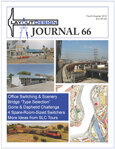
LDJ-66 FOURTH QUARTER 2019 (FULL-COLOR, 40 PAGES)
Issue #66 of the Layout Design Journal is a rich exploration of how layout designers approach visual realism, operational complexity, and space optimization through both prototypical fidelity and freelanced creativity. The issue includes in-depth examples ranging from spare-room switching layouts to mountain railroading challenges, with a recurring theme of adapting layouts to the real-world constraints of home spaces, operator ergonomics, and scenic balance.
Bill Goodenough opens the issue with a spare-room-sized switching layout designed to showcase his scratchbuilt structures. Set in California’s Central Coast region, the layout blends scenic authenticity with practical operating patterns, emphasizing visual storytelling through architectural modeling. Mike McGinley’s article offers a cautionary tale about applying real-world bridge engineering logic to model design without full consideration of scenic context—his 42-inch duckunder bridge may be structurally sound, but visually it clashes with the modeled landscape.
Rick Mugele presents a design challenge tribute to John Allen’s Gorre & Daphetid, reimagining it as the Cripple Creek Short Line with contemporary layout planning sensibilities. Mugele’s piece is notable for its deep contextual analysis, contour-aware planning, and intentional compromises that balance visual spectacle and operations. Olaf Melhouse closes with four compact switching designs in N and HO scale that show how high operational interest can be maintained in tight spaces, with thoughtful staging, industrial themes, and prototypical cues.
Throughout the issue, key modeling strategies include the use of fascia-mounted turnout controls, multi-function spaces (like layouts above desks), rail-marine operations, realistic staging with drawers or shelves, and historic railroad inspiration. The articles reinforce the idea that good design evolves iteratively—through feedback, real-world constraints, and creative reinterpretation.
Table of Contents
Articles
Scratchbuilt Structures and Switching – Bill Goodenough – Page 4
Bridge “Type Selection” Gone Bad – Mike McGinley – Page 10
Gorre & Daphetid Mountain Challenge – Rick Mugele – Page 15
Four Spare-Room-Sized Switchers – Olaf P. Melhouse – Page 24
More Design Ideas from SLC NMRA 2019 Tours – Page 34
Railfan, Display, Scenery & Fantasy Challenge – Page 36
Columns / Departments
What the Heck? – Ron Burkhardt – Page 3
Sharing the SIG – Byron Henderson – Page 3
New LDSIG Groups.io Discussion Forum – Chris Mesa – Page 37
LDSIG Webmaster Needed – Bob Hanmer – Page 37
2019 LDSIG Annual General Meeting Report – Cal Sexsmith – Page 38
Future Meets: Sacramento; Tulsa; St. Louis – Page 39
3. Detailed Article Summaries
Title: Scratchbuilt Structures and Switching
Author: Bill Goodenough
Railroad Modeled: Freelanced based on San Ardo, CA
Layout Scale: HO
Layout Size: 9′ x 11′ bedroom (shelf layout around 4 walls)
Techniques: Scratchbuilt structures, fascia-mounted switch controls, staging drawers, “sure spots,” shelf-style benchwork, around-the-room point-to-point with continuous loop, structure-based layout design
Summary:
Bill Goodenough’s layout began as a way to display large scratchbuilt structures, evolving into a fully operational HO scale shelf layout based in the San Ardo area of California’s Central Coast. Designed with the help of David Griffy, the plan developed into an around-the-room configuration with staging yards doubling as the layout’s terminals—King City and Templeton. While primarily freelanced, it includes realistic prototypes like Miller’s Market and a modified Purina Chows building. The layout features fascia-mounted turnout controls using PVC pipe mechanisms and hidden car storage in drawers. It offers realistic switching with seventeen spotting locations, a continuous mainline, and visual depth through scenic flats. A practical and visually engaging model railroad, it showcases the synergy between structure modeling and layout design.
Title: Bridge “Type Selection” Gone Bad
Author: Mike McGinley
Railroad Modeled: Southwestern Pacific (fictional)
Layout Scale: HO
Layout Size: 18′ x 22′ room layout
Techniques: Engineering-based bridge modeling, scenic integration, continuous-run with duckunder, modular benchwork, civil engineering principles
Summary:
Mike McGinley, a professional railroad engineer, reflects on a misstep in layout design: incorporating a 42″ through-truss duckunder bridge that was technically sound but visually inappropriate. While his goal was to model bridge selection per real-world structural engineering logic, the resulting structure clashed with the layout’s Southwestern U.S. desert setting. Though the bridge was effective functionally and even disguised with weathered paint and camouflage, it ultimately disrupted scenic cohesion and proved ergonomically problematic. McGinley discusses lessons learned, including the importance of fitting scenic elements into layout context and designing access with user comfort in mind. The bridge was removable for operations and photography but remained a cautionary design tale.
Title: Gorre & Daphetid Mountain Challenge
Author: Rick Mugele
Railroad Modeled: Freelanced “Cripple Creek Short Line” inspired by G&D
Layout Scale: HO
Layout Size: 16′ x 22′
Techniques: Scenic-first design, single-level with multi-pass track, mining district theme, hidden staging, removable scenery, narrow aisles, mirror effects, vertical scenery contours, homage to John Allen’s layout philosophy
Summary:
Rick Mugele undertakes a thoughtful tribute to John Allen’s legendary Gorre & Daphetid layout with a design challenge of his own: create a G&D-inspired layout with similar scenic and operational flavor in a more manageable footprint. The resulting Cripple Creek Short Line incorporates multiple laps of single-level track, dramatic scenic contours, staging, and compact industrial operations in a mining region setting. Mugele balances visual artistry with operational logic, incorporating ore and coal traffic, helper grades, and turnback loops while avoiding the multi-deck complexity of modern design. His article dives into layout history, practical scenery building, operator flow, and even humorous details like “adjustable chimneys” on buildings. It’s a rich, story-filled article that celebrates creative layout adaptation and scenic immersion.
Title: Four Spare-Room-Sized Switchers
Author: Olaf P. Melhouse
Railroad Modeled: Kansas City Southern, DQE, and other fictional shortlines
Layout Scale: N and HO
Layout Size: Spare-room-sized layouts, typically wall-sized or with peninsulas
Techniques: Industrial switching, helper operations, single-track mainlines with passing sidings, compact terminal planning, Class I and shortline modeling, CTC ops
Summary:
Olaf Melhouse presents four detailed layout designs for spare-room spaces, each emphasizing prototypical switching operations in either N or HO scale. The standout is a Kansas City Southern line over Rich Mountain, complete with helper grades, passing sidings, and realistic freight flows. Other plans include interchange-heavy switching districts and yard-centric shortlines, all using 1950s to modern-era settings. Melhouse offers not only diagrams but detailed traffic flow commentary and prototype backstories. These layouts deliver high operational interest and prototypical flavor in manageable footprints, making them ideal inspiration for space-conscious modelers.
Would you like this entire analysis exported to a Word document for download?
4o
You said:
missing two articles
ChatGPT said:
Here are the final two article summaries from LDJ Issue #66 (Fourth Quarter 2019):
Title: More Design Ideas from SLC NMRA 2019 Tours
Author: Don Winn (photos and text), Bruce Morden, Peter Kerr, and others
Railroad Modeled: Various tour layouts (no specific layout focus)
Layout Scale: Various
Layout Size: Various home and club layouts
Techniques: Human factors, benchwork design, fascia detailing, car-card storage solutions, roadbed construction methods
Summary:
This photo-essay article shares benchwork, access, and visual ergonomics innovations observed during layout tours at the 2019 NMRA Convention in Salt Lake City. Jon Robinson demonstrates an alternative spline roadbed method using PVC trim molding and Homasote. Gary Peterson repurposes wire hangers as effective but nearly invisible train guardrails. Other innovations include slanted pigeonhole-style car-card holders by Bob Gerald to save aisle space, and Rob Spangler’s fascia-colored card boxes that blend seamlessly with the surrounding scenery. Additional details showcase painted route indicators on ground throws and discrete car-card sorting racks. The article emphasizes small adjustments that enhance operational ease and visual harmony, providing modelers with accessible and practical layout enhancements.
Title: Railfan, Display, Scenery & Fantasy Challenge
Author: LDSIG Editors
Railroad Modeled: N/A (design challenge announcement)
Layout Scale: Any
Layout Size: Unlimited (user-defined)
Techniques: Creative theming, public display planning, fantasy settings, scenic presentation, animation elements, cross-sectional and view-focused layout planning
Summary:
This design challenge invites layout designers to think beyond traditional railroad modeling and into creative realms of railfan display, public exhibition, scenic storytelling, or outright fantasy. Unlike past challenges with specific spatial constraints, this call for entries allows modelers to define their own space and theme, from a compact diorama to a sprawling sci-fi setting. Designs might reflect a single-scene photo spot, a railfan’s dream staging hub, or whimsical concepts such as cartoon or literary worlds. The article encourages the use of imaginative elements like animation, cross-sectional views, and viewer sightline planning, with a practical approach to staging and portability for display purposes. All scales, time periods, and fictional settings are welcome. Contributions can be supported by LDJ volunteers and may be published in future issues of the journal.
Download a free sample of pages from this issue.
To download the issue login to your member account: click “here“.
Non-members can join or renew: Click “here“