
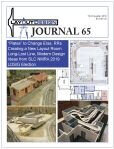
LDJ-65 THIRD QUARTER 2019 (FULL-COLOR, 40 PAGES)
Layout Design Journal Issue 65 continues its mission of promoting thoughtful and practical layout design through a series of richly detailed and creatively varied articles. This issue’s overarching themes include modular staging techniques, historical research integration, adapting layout rooms to personal spaces, and envisioning modern railroading based on historical prototypes. The content highlights a strong interest in switching layouts, freelance designs with historical grounding, and innovative solutions for realistic and engaging operation in compact spaces.
The lead article, “Plates Enable Changeable Eras” by Mike McGinley, explores an ingenious way of enabling multi-era operations through replaceable scenic and structural elements, offering flexibility for both display and operational contexts. Don Winn’s piece on designing a custom layout room within a new home construction illustrates how model railroading can influence architectural planning, and how layout utility can be maximized with careful foresight.
A particularly noteworthy entry is Jeremy Dummler’s “Modern Version of a Long-Lost Line,” which imagines the resurrection of the Palatine, Lake Zurich, & Wauconda line as a contemporary switching layout. This project integrates strong prototypical research with modern modeling, offering operational challenge in a modest footprint.
Additionally, Byron Henderson contributes an article about using historical topographic maps in layout planning, showing how these resources aid in authenticity and context when designing from real geography. The issue also includes a photo-feature article collecting benchwork and ergonomic ideas from the SLC 2019 NMRA tours, reinforcing the journal’s commitment to practical, user-tested design concepts.
The diversity of layout scales (mostly HO), time periods (past to present), and operational approaches (from single-operator to multi-crew designs) reflects an encouraging trend toward layouts that prioritize both operational interest and spatial efficiency. Collectively, the issue balances technical insights with conceptual inspiration, supporting layout designers at all experience levels.
Table of Contents
Articles
“Plates” Enable Changeable Eras – Mike McGinley – Page 4
Creating a New Layout Room in a Custom Home – Don Winn – Page 9
Modern Version of a Long-Lost Line – Jeremy Dummler – Page 24
Free Online Historical Topo Maps – Byron Henderson – Page 29
Design Ideas from SLC NMRA 2019 Tours – Various – Page 31
Railfan, Display, Scenery & Fantasy Challenge – LDSIG – Page 34
Columns/Departments
The End of the LDJ… 2020? – Byron Henderson – Page 3
Perspective and Vision – Ron Burkhardt – Page 3
Board of Directors Election Results – Ron Burkhardt – Page 28
LDJ Comments – Various – Page 33
LDSIG Board of Directors Election – Page 35
Future Meets: Bay Area; Tulsa; St. Louis NMRA – Page 36
Thanks to Volunteers: SLC NMRA 2019 – Page 39
LDSIG Back Issues – Page 39
Detailed Article Summaries
Title: “Plates” Enable Changeable Eras
Author: Mike McGinley
Railroad Modeled: Southwestern Pacific (freelanced)
Layout Scale: HO
Layout Size: Not specified
Techniques: Modular scenic/structural elements, historical replication, multi-era operations
Summary:
Mike McGinley presents an innovative approach to modeling different historical eras on the same layout using swappable “plates”—modular structures and scenery sections that can be physically replaced to reflect different time periods. This method allows operators to experience freight and passenger operations from 1946, 1955, 1971, and 2006 with reasonable historical accuracy. The article details the logic behind the plates, how they’re constructed and stored, and the operational and aesthetic benefits they provide. The approach is ideal for prototype-inspired freelancers who wish to explore different historical scenarios without building entirely new layouts.
Title: Creating a New Layout Room in a Custom Home
Author: Don Winn
Railroad Modeled: Not named (personal/future layout)
Layout Scale: HO (implied)
Layout Size: Dedicated train room in new custom home
Techniques: HVAC planning, ergonomic benchwork, modular sections, utility integration
Summary:
Don Winn shares his experience designing and constructing a model railroad layout room from scratch while building a custom house. This article is a hybrid of personal narrative and technical insight, detailing decisions about HVAC, insulation, cabinetry, and workspaces to optimize the model railroading experience. He emphasizes user comfort, flexibility (quasi-sectional benchwork), and operational flow, illustrating how hobby considerations can harmoniously integrate into residential construction. The train room is designed with future layout building in mind, laying the groundwork for an efficient and enjoyable modeling space.
Title: Modern Version of a Long-Lost Line
Author: Jeremy Dummler
Railroad Modeled: Palatine, Lake Zurich, & Wauconda (proto-freelanced)
Layout Scale: HO
Layout Size: ~10′ x 10′ spare-bedroom-sized
Techniques: Switching layout, narrow benchwork, sectional design, customer-agent ops, paperwork flow
Summary:
This article revives the short-lived PLZ&W line as a modern-day switching layout located in Wauconda, IL. Dummler imagines what rail service might look like today if the line had survived, serving small industries in a thriving downtown setting. The design prioritizes shallow benchwork and realistic switching patterns, with operations managed by a small crew and supported by a dispatcher who may double as customer agent. Multiple versions of the track plan are explored, adapting the design to common spare-bedroom spaces and reflecting the author’s interest in ergonomic operator flow. A strong emphasis on operations, realistic paperwork, and car variety makes this layout design both engaging and practical.
Title: Free Online Historical Topo Maps
Author: Byron Henderson
Railroad Modeled: Ocean Shore Terminal (proto-freelanced)
Layout Scale: N/A (research tool)
Layout Size: N/A
Techniques: Layout research, map overlay, proto-freelancing, online GIS
Summary:
Byron Henderson introduces readers to the USGS Historical Topographic Map Explorer, a powerful online tool for layout designers seeking to replicate or base designs on real-world geography. Using overlaid maps from different eras, the site allows users to track changes in rail lines, streets, and natural features. Henderson demonstrates how he used the tool to inform the design of a proto-freelanced Ocean Shore Terminal layout. He outlines how to use the interface, interpret the data, and apply it to layout planning. This article serves as both a tutorial and a practical case study in leveraging digital cartographic resources for historically grounded layout design.
Title: Design Ideas from SLC NMRA 2019 Tours
Author: Various (photos and text by multiple contributors)
Railroad Modeled: Various layouts from NMRA tour
Layout Scale: HO (mostly)
Layout Size: Various
Techniques: Ergonomic design, visual continuity, modular roadbed, open helix, fascia-integrated backdrop
Summary:
This visual essay captures a variety of practical design and construction ideas seen during layout tours at the 2019 NMRA convention in Salt Lake City. Topics include alternative spline roadbed construction using PVC, car-card storage solutions, fascia-integrated backdrops, adjustable risers using steel brackets, and visually open helices. These insights reflect evolving best practices in model railroad ergonomics and presentation, emphasizing ease of construction and operator experience. Each photo is accompanied by descriptions of the technique and its implementation context, making this article a useful grab bag of design ideas for both new and seasoned layout builders.
Title: Railfan, Display, Scenery & Fantasy Challenge
Author: LDSIG Editors
Railroad Modeled: N/A (challenge format)
Layout Scale: Any
Layout Size: Any – participant-defined
Techniques: Creative layout design, exhibition planning, animation elements, fictional theming, photo cross-sections, scenic storytelling, to-scale planning
Summary:
This article introduces the Layout Design SIG’s 2019 open-ended design challenge, inviting layout designers to explore the thematic realms of railfan display, scenery-forward design, public exhibition, and fantasy-themed railroads. Unlike previous challenges constrained by specific dimensions or spaces, this one offers unlimited creative flexibility—encouraging submissions that might range from compact dioramas and museum-style displays to grand narrative environments drawn from literature, pop culture, or personal imagination. Suggested techniques include the use of animation, imaginative scenic design, and layouts with a strong visual or storytelling element. Designers are encouraged to provide to-scale track plans and visual aids like aisle-view sketches or cross-sections to help convey their concepts. The editors also provide practical tips for submissions, welcoming both first-time and experienced contributors.
Download a free sample of pages from this issue.
To download the issue login to your member account: click “here“.
Non-members can join or renew: Click “here“