
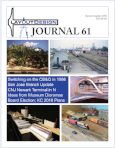
LDJ-61 SECOND QUARTER 2018 (FULL-COLOR, 40 PAGES)
Layout Design Journal Issue 61 (Second Quarter 2018) places a strong emphasis on switching-oriented designs, highlighting how realistic operations and compressed prototypes can be adapted into home layouts. The issue explores a wide range of scales, from HO to N, and demonstrates the creativity required to translate large railroad operations into compact spaces. Don Winn’s feature on the CB&Q in Aurora, Illinois, sets the tone by showing how a full basement concept can be distilled into a bedroom-sized switching challenge, balancing industry density with operational flow. Michael Hardwick’s Western Pacific San Jose layout continues this theme with progress updates, showing how a modest N scale layout can carry deep prototype fidelity and operating interest. Jonathan Jones’s exploration of the CNJ Newark Branch adds an artistic and architectural dimension to layout design, marrying historical research with aesthetic choices that focus attention on the railroad itself. The issue further includes Nicholas Kalis’s insights from museum dioramas, which translate display techniques into model railroad settings, and Don Winn’s benchwork tips inspired by conventions. Together, these contributions underscore a movement toward prototypical fidelity, urban and industrial switching, and creative problem-solving for small spaces. Themes of compression, staging strategies, and balancing realism with practicality resonate throughout, offering readers both inspiration and practical tools to improve their own layout planning. The issue also marks the LDJ’s return to regular publication, with updates from leadership on organizational efforts, upcoming conventions, and volunteer opportunities. Overall, Issue 61 reflects the evolving sophistication of layout design while remaining grounded in the collaborative spirit of the LDSIG.
Table of Contents
Features
Switching the CB&Q in Aurora, IL – Don Winn – p.4
WP in San Jose Progress Report – Michael Hardwick – p.11
CNJ’s Newark & New York Railroad – Jonathan Jones – p.14
Learning from Museum Masters – Nicholas Kalis – p.30
Benchwork Ideas from Orlando 2017 – Don Winn – p.33
News and Departments
LDJ Update – Byron Henderson – p.3
LDJ, Volunteers, Kansas City – Ron Burkhardt – p.3
Future LDJ Articles and Topics – p.32
LDSIG Board of Directors Election – p.35
LDJ Questions, Comments, Corrections – p.39
KC NMRA 2018, LDSIG Annual Meeting – p.40
Switching the CB&Q in Aurora, IL
Author: Don Winn
Railroad Modeled: Chicago, Burlington & Quincy (Aurora, IL)
Layout Scale: HO
Layout Size: 10′ x 10’10” plus closet
Techniques: Switching focus, staging yard, compressed prototype industries, street running, drop-leaf sections
Don Winn’s article explores how the CB&Q’s Aurora, Illinois operations can be compressed into a bedroom-sized switching layout. Aurora was a hub for commuter, passenger, and freight traffic, and Winn distills this complexity into a selective representation of the Alley Job, Montgomery industries, and the West Batavia branch. The design employs a G-shaped plan with staging, Eola yard compression, and key industries like Caterpillar, Lyon Metal, and Stephens-Adamson. Special attention is paid to closet integration, removable scenery, and staging below the main level. Operations are rich, with multiple locals and switching jobs, while prototype scenes such as the Fox River bridge are faithfully represented. The article demonstrates balancing realism with room constraints, making it both a personal design exercise and an inspirational example for readers.
WP in San Jose Progress Report
Author: Michael Hardwick
Railroad Modeled: Western Pacific (San Jose Branch)
Layout Scale: N
Layout Size: 1.5′ x 10′ with removable staging
Techniques: Compact prototype modeling, traverser staging, sectional design, DCC control
Michael Hardwick provides an update on his compact N scale Western Pacific layout, first introduced in LDJ-58. The layout captures the San Jose branch with signature features such as Sunol siding, Borchers Brothers cement plant, and the Western Pacific freight depot. The design uses sectional benchwork, a traverser staging system, and removable shelves for dual-purpose room use. Hardwick highlights operational flow with small industries such as fruit packers and ice docks while maintaining fidelity to the prototype’s appearance. His progress illustrates how thoughtful design can yield a rich operating environment in limited space, emphasizing that small layouts can still provide deep engagement with a prototype.
CNJ’s Newark & New York Railroad
Author: Jonathan Jones
Railroad Modeled: Central Railroad of New Jersey (Newark Branch)
Layout Scale: N
Layout Size: Approx. 7′ x 20′ (shelf-style in apartment)
Techniques: Urban switching, shelf design, artistic backdrop treatment, staging yard
Jonathan Jones reimagines the CNJ Newark Branch in an N scale shelf layout designed for an apartment. Drawing inspiration from historical research and architectural sensibilities, Jones models the Broad Street terminal, East Ferry Street truss bridge, and key industries such as Celanese Chemical and Lehigh & Wilkes-Barre Coal. The design emphasizes artistic presentation, with subdued backdrops to focus viewer attention on trains and infrastructure. Jones integrates staging to represent connections beyond the modeled portion, while handlaid Code 55 track ensures prototypical fidelity. The article is as much about design philosophy as layout construction, advocating for minimalism, selective compression, and visual focus in N scale. It demonstrates how a small-space urban railroad can deliver operational depth and aesthetic sophistication.
Learning from Museum Masters
Author: Nicholas Kalis
Railroad Modeled: Not specific (lessons from museum dioramas)
Layout Scale: Applicable across scales
Layout Size: Conceptual guidance rather than fixed size
Techniques: Diorama composition, selective detailing, visual storytelling
Nicholas Kalis examines how museum dioramas provide lessons for layout design. He highlights techniques such as controlled sightlines, focal points, and abstraction to convey narrative power. By applying museum display strategies, modelers can enhance realism, evoke emotion, and improve visual clarity. The article emphasizes that not every detail must be modeled literally; instead, carefully chosen features can convey atmosphere and context more effectively. Kalis encourages readers to think like exhibit designers, using composition and focus to elevate model railroading from miniature replication to immersive storytelling.
Benchwork Ideas from Orlando 2017
Author: Don Winn
Railroad Modeled: General applications
Layout Scale: Applicable across scales
Layout Size: Convention demos and practical examples
Techniques: Benchwork design, modular framing, storage integration
In this short piece, Don Winn shares insights gained from the 2017 Orlando convention on benchwork construction. He presents practical approaches to modular benchwork, integrating storage, and supporting varied layout configurations. While less detailed than his CB&Q feature, this article reinforces the idea that strong, flexible benchwork underpins successful layout design. Winn underscores the importance of accessibility, ergonomics, and adaptability in creating a foundation that will support both long-term use and creative expansion.
Download a free sample of pages from this issue.
To download the issue login to your member account: click “here“.
Non-members can join or renew: Click “here“