Bob Johnson’s Pseudo Soo Line
“The Swamp Level Route”
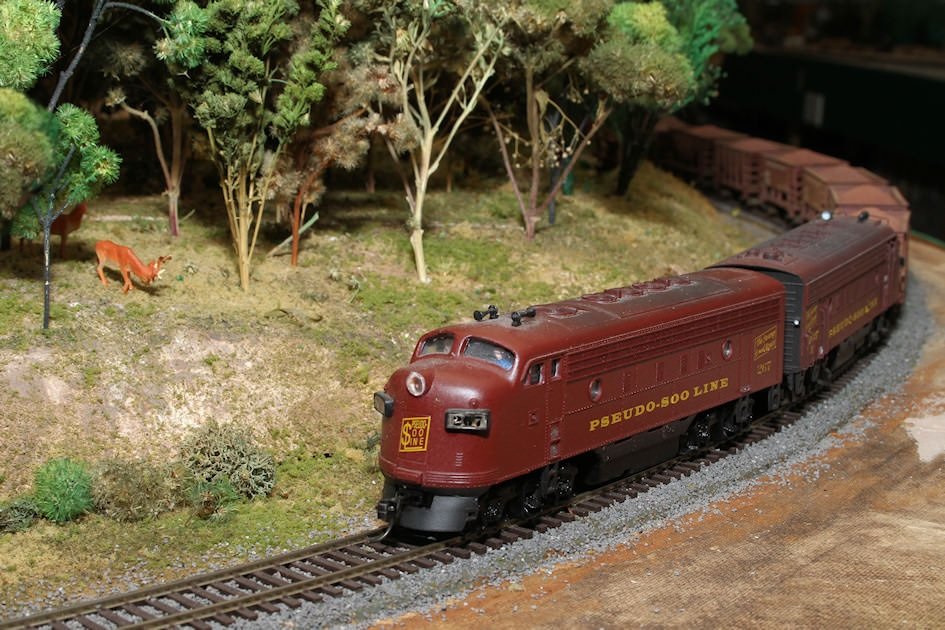
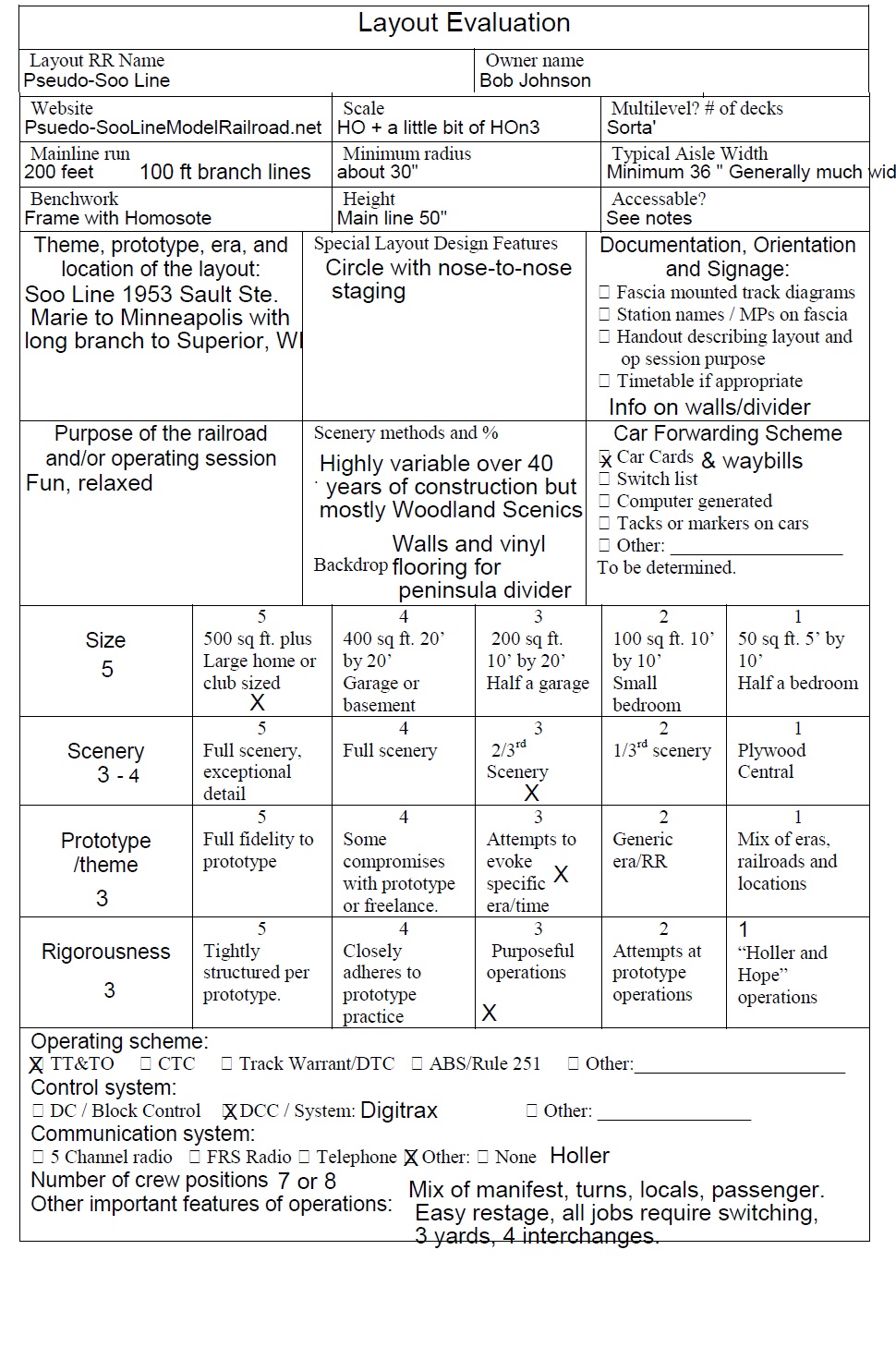
The HO scale Pseudo-Soo Line (PSL) is set in north central Wisconsin in the late spring of 1953, the week of June 15th to be precise. It represents the Third Division of the Gladstone Division of the “Old Soo” (before the 1961 merger of the Minneapolis, St. Paul, & Sault Ste. Marie; the Wisconsin Central; and the Duluth, South Shore, & Atlantic). Its emphasis is on forest, lake, and agricultural products as it traverses the swamps and bogs of the area. Although a specific time and locale are represented, scenery, rolling stock, etc. are not claimed to be prototypical but only to give the flavor of the place and period.
The original Pseudo-Soo Line was located in Golden Valley (Minneapolis), Minnesota, and was on the Northstar99 layout tours. We moved into this basement, then totally barren, in April 2000, and the new Pseudo-Soo Line was up and running for the Gateway2001 layout tours 15 months later. Approximately 230 model railroad enthusiasts visited the layout during the convention.
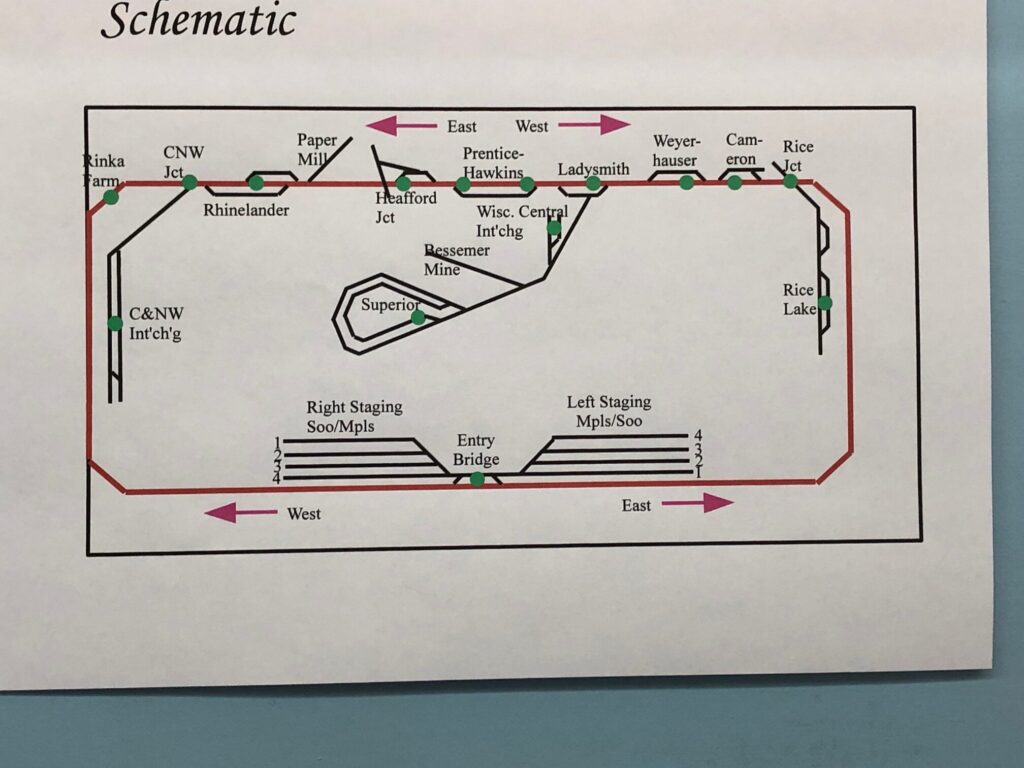
The new PSL occupies a space 50′ long and 12′ to 22′ wide. It is an “around the walls” layout with a long center peninsula. The mainline is a closed loop with two single ended, “nose-to-nose” staging yards. These represent Sault Ste. Marie, MI (“The Soo”) and Minneapolis, MN. The main loop from “The Soo” to Minneapolis is approximately 200′ long. Another 100′ of track represent branch lines and interchanges. Abracadata 3D Railroad Concept and Design software was not only used to design the layout but the entire basement. [This software is no longer available.] The design was essentially complete before we moved in, and I have made very few changes to the original design.
The three classification yards: Rhinelander, Ladysmith, and Weyerhauser. There is a passing siding between Prentice and Hawkins, and two short run-around tracks elsewhere. A branch line leads to a reversing loop that represents the Wisconsin Central routes to Superior, WI and the Bessemer, MI iron mine complex. Another branch line goes to Rice Lake, WI. There are 60 industries including team tracks and ice houses, plus four standard gauge interchanges: C&NW at Rhinelander, The Milwaukee Road at Heafford Junction, the Wisconsin Central at Ladysmith, and the C&NW at Rice Lake. The narrow gauge Thunder Lake logging railroad crosses the PSL at Robbins Junction and transfer hardwood logs going to several online users. The hand-laid Thunder Lake RR module is the only part of the layout used intact from Golden Valley.
Operation include both passenger and freight movements. The Atlantic Limited (East and West) and the Superior Lake (North and South) represent high-class varnish. All runs include some switching moves. The Milk Runs (East and West) drop-off and pick-up cars at Lassig Dairy and make a number of stops for passengers and milk. There are 13 freight jobs including manifests, peddlers, ore trains, turns, and dedicated industry and interchange moves. A 6:1 fast clock is used, so the seven or more operators required to run the railroad keep busy during a typical 3-hour session.
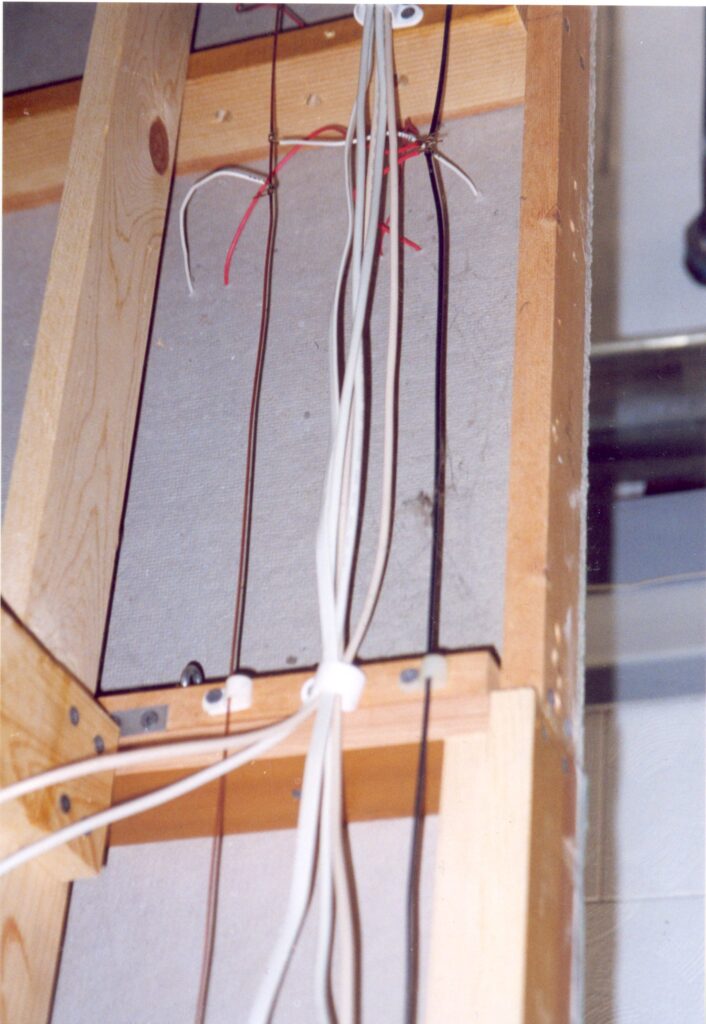
Digitrax DCC is used. A 6-wire telephone bus forms a LAN to all points of the layout with jacks along the fascia. There are also receivers for infrared and radio (both simplex and duplex) throttles. Guest operators are invited to bring their own compatible throttles. All turnouts are hand-thrown with Caboose Industries throws.
About 100′ of background was done by my wife, Prue, using stamp-art techniques. About 25′ were completed for NorthStar99 in Golden Valley, and the rest were done here. These backdrops have provoked considerable comment and interest. I believe this is unique in model railroading. Clouds on the primary backdrops were painted by Prue using sponges and brushes.
The Paper Mill area has a realistic appearance through the use of photographs of actual pulpwood piles. The real Rhinelander Paper Mill now uses commercial wood pulp rather than raw logs, and I did not have good photos from “the old days”. However, I came upon the Potlatch Mill in Cloquet, MN and took panaramic photos of their log piles. I scanned these into my computer, enlarged, touched up, and printed them. The printed enlargements were glued to poster board and placed in front of the backdrop. Three dimensional scale log piles give the final feeling of depth.
Another unique feature is the nose-to-nose staging yards. I could not get enough rise to provide good clearance at the duck-under entry if I had used a double-ended design. Instead, my mainline peaks at the entry, and the stub-ended staging yards extend in opposite directions from there. Trains arriving at The Soo (railroad East), for example, enter the left staging yard and terminate at the bumpers. Trains departing from this same staging yard are departing from Minneapolis. They first back out of the stub onto the mainline before proceeding eastward toward The Soo. Westward facing trains use the opposite staging yard. Overall, the arrangement is to one double-ended yard and has worked nicely.
The railroad is essentially flat (mainline at 50″ high, lower level on peninsula 44″, staging 58″) to not only represent the relatively flat terrain of north central Wisconsin (a PSL nickname is “The Swamp Level Route”) but also to maximize operational reliability. Maximum grades to the staging yards and Wisconsin Central are about 3%. Entry bridge clearance is 57″.
The benchwork uses both box grid and L-beam construction overlaid with ½” Homasote. I have found that by keeping joists fairly close together and avoiding “cookie cutter” design, I do not need a sub-roadbed of plywood although there is a little sagging in places. I did use plywood sub-roadbed in the staging yards and glued and screwed two layers of Homasote together for the roadbeds leading to the staging yards and the lower level loop.
Standard gauge trackwork is Atlas Code 83 nickle-silver flex track and Code 83 Customline #4 and #6 turnouts. Narrow gauge trackwork is a combination of hand-laid Code 70 and Code 55.
A challenge on an active operating layout is to plan sidings, buildings, and scenery, so operators can reach working areas without damaging the scenery. To this end, most sidings are on the aisle side of structures. No structure is more than two stories tall except for paper mill buildings. Taller buildings are placed close to the backdrop with single story structures closer to the aisle. There are no tall trees in areas operators might be required to reach over.
Come take a ride on the Pseudo-Soo Choo! Our motto is “We give prompt service no matter how long it takes”, and we guarantee our service! We hope you enjoy your visit.
Bob & Prue
Early Construction Photos
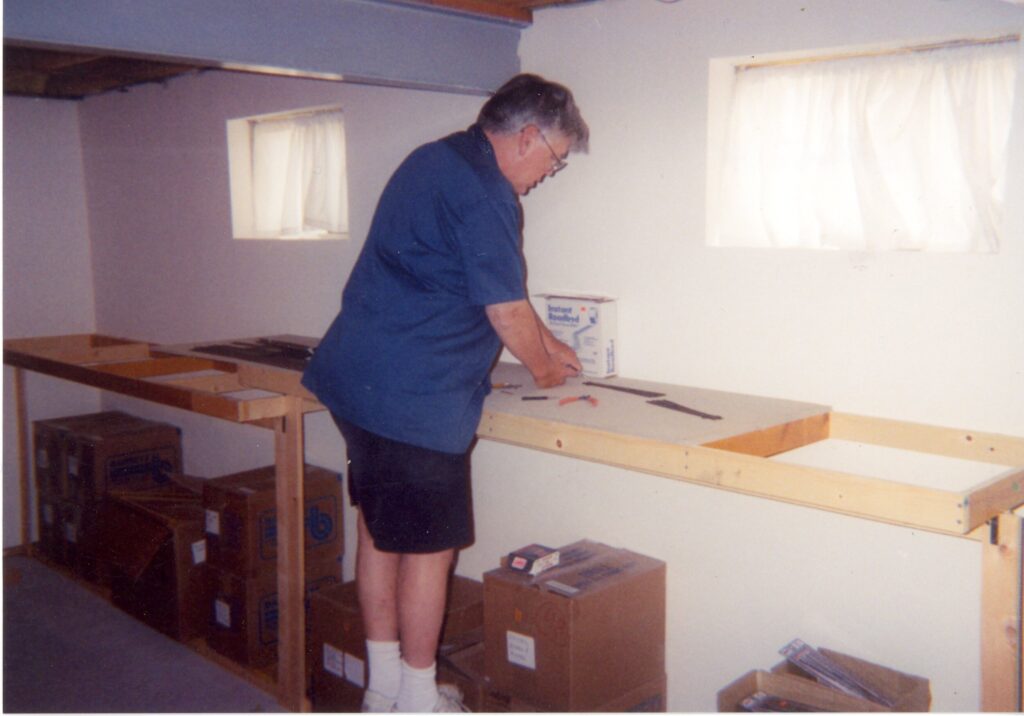
Bob working on the first area developed that became the Ladysmith area. The view is toward the east. The basic module size of 2′ x 8′ is shown. The lower section establishes the lower level of the peninsula. The photo shows one of the design features – – a lot of room under the layout for storage! All wiring will eventually be run just below the frame and behind the future fascia for easy accessibility.
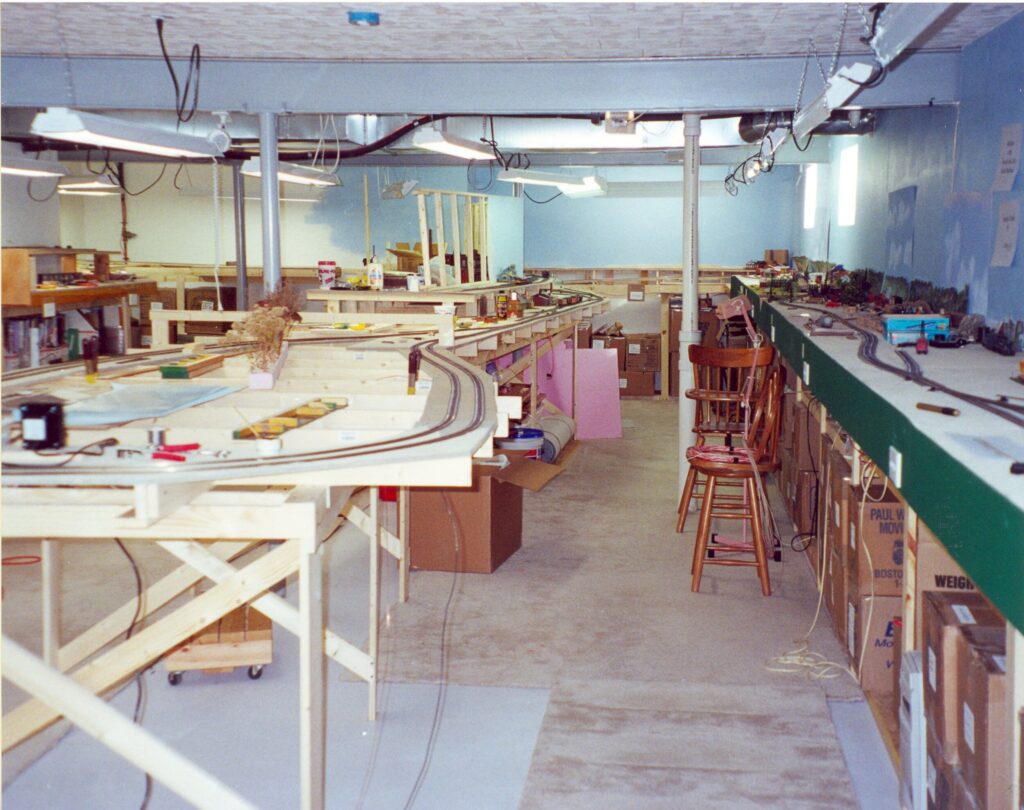
The peninsula under construction. The double loop of track is on the lower level and forms the single reversing loop. In the distance can be seen the upper level which will support the mainline, the Rhinelander area, and the paper mill. Beyond that are the beginnings of the peninsula divider. On the right of the image is the Weyerhauser area looking east toward Ladysmith. Plenty of cabling/wiring hanging loose! Note florescent fixtures over the Weyerhauser are tilted inward to direct light onto the layout rather than the aisle and eliminates/reduces the need for valences. The entrance way into the layout is just off the image on the far left.
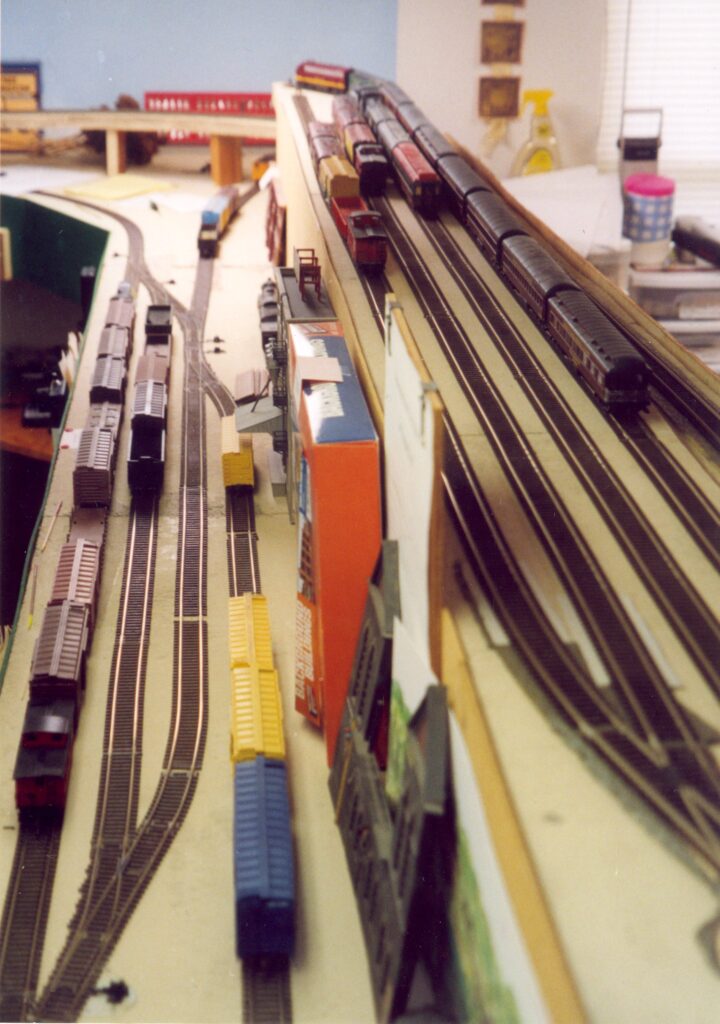
View from above the entry way toward the left staging yard (upper level) and the Rice Lake Interchange and industries. The track on the far right is the mainline looking east going down to the main level of the layout.
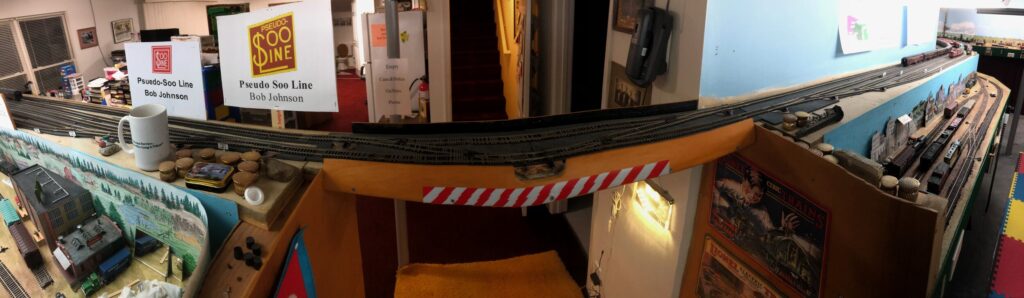
The entry bridge is semi-permanently in place with horizontal door hinges. It can be removed by unplugging the power lead at one end, sliding the track joiners back, and removing the door pins. I have had to do that once or twice in 25 years, but the design is a “nod under” with rug to bridge bottom of 57″ to 58″. The curvature is due to photo distortion; the bridge is actually straight.
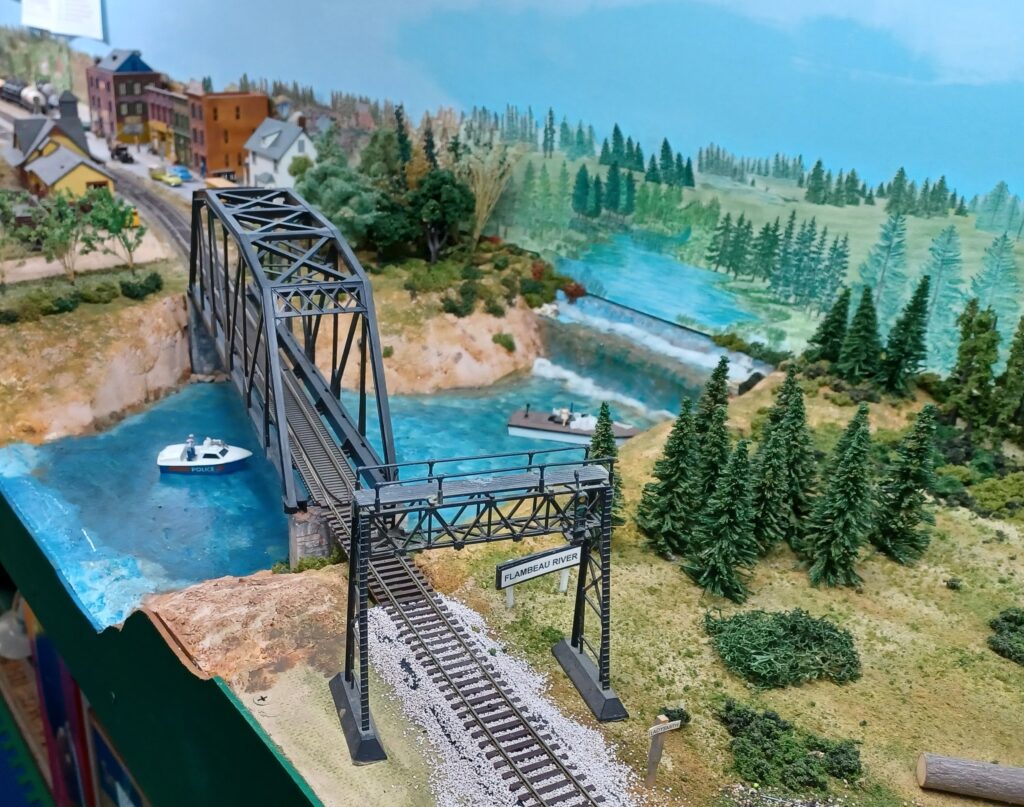
The Department of Natural Resources police checking out a couple of ladies enjoying the warm spring day below the Ladysmith dam. Lower right scenery shows the few pines left standing after 100 years of intensive logging. Upper right demostrates stamp art skill by Prue. Upper left across the bridge is the town of Ladysmith. The yellow structure is the depot.
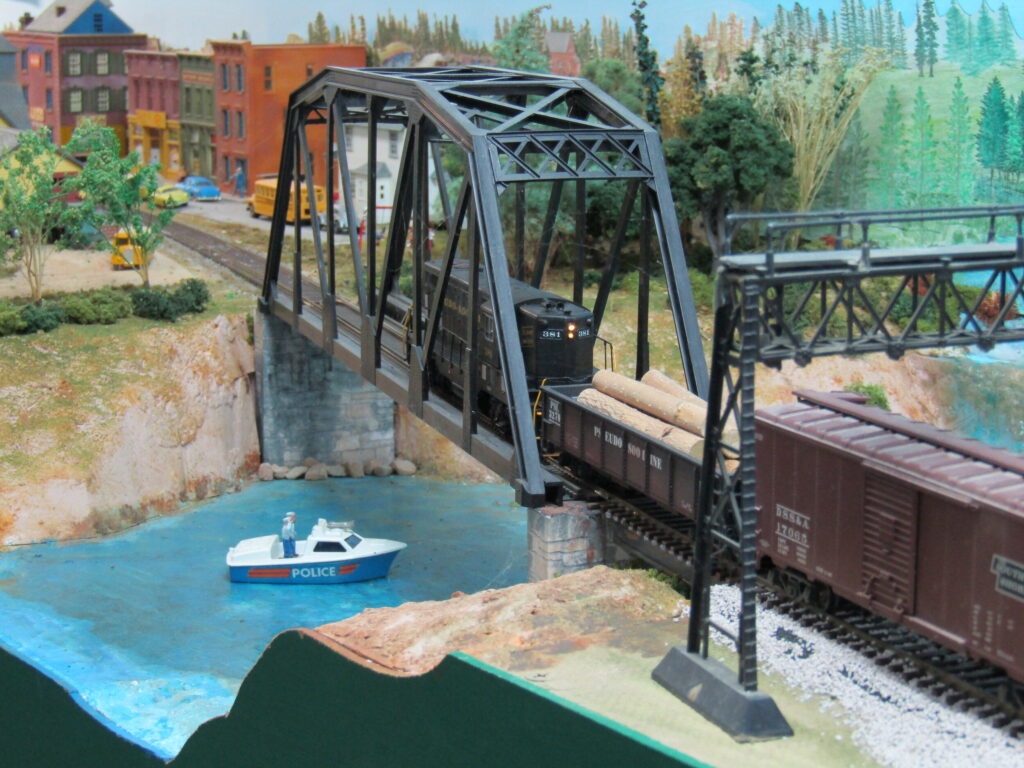
“The Peddler East” crosses the Flambeau River bridge approaching Ladysmith. The log gon and several other cars will be dropped at Ladysmith for the Wisconsin Central Turn. The PE will also pick-up cars at Ladysmith to deliver to Baker’s Flour, Heafford Junction, and Rhinelander. The DNR water patrol is checking out a couple of ladies enjoying a warm June day below the dam. The backdrop was created by Bob’s wife using “Stamp Art”.
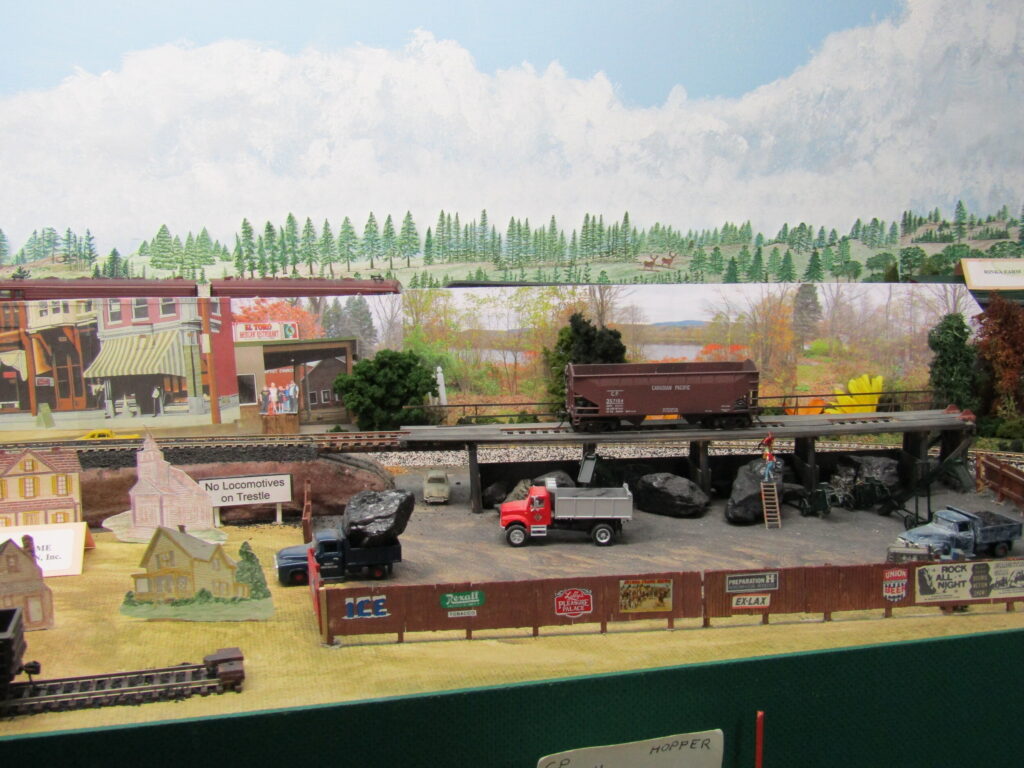
Our coal yard with real Peabody coal. Workers with picks are busting up an oversized lump that came from the southern Illinois mine. A more frugal customer is taking a large lump home in his pickup for do-it-yourself sizing. The coal yard is on the main level. The Atlantic Limited East is mostly hidden behind the near backdrop as it climbs towards Staging/The Soo. The river on the near backdrop is the Connecticut River stitched together from photos taken in October 2010 from my older son’s backyard in New Hampshire. To the left are photo realistic building murals in Chillicothe, MO take about 2015. My younger son’s family is standing in front of the El Toro Mexican Restaurant. The far background is “Stamp Art” on poster board created by rubber stamps and pencils produced by my wife, Prue. She has made these backdrops for most of the 200′ of mainline. They really give a lot of depth to the scene, and I do not know that anybody else has ever bedecked their layout with stamp art.
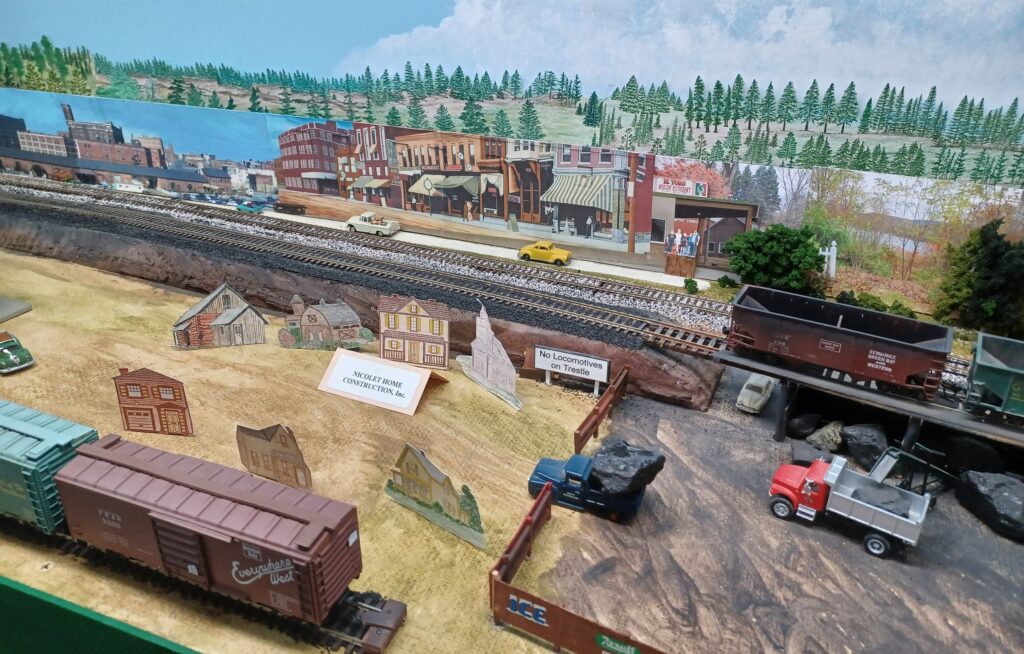
The Rhinelander coal dock is in the foreground. Hoppers dump large lumps of Genuine Peabody coal directly from 3-bay hoppers to ground level for sorting and sizing. Coal Dock employees disassemble major lumps of coal by hand. Portable conveyors move the sized coal into one-ton and 3/4 ton dump trucks for delivery to customers. A small pickup truck is taking a large lump home for do-it-yourself sizing for a substantial discount. The background track is the track from the PSL main to the C&NW interchange.
The intermediate background is composed of stitched together photos taken over a 10 to 15 year period. On the far right is the Connecticut River below my older son’s former home in New Hampshire. This photo taken in 2005. The bright, large flowers are plastic. Next to the left beyond the yellow vehicle is photo-realistic murals painted on buildings in Chillicotee, MO. My younger son and family pose on the front porch of the El Toro Pizza Restaurant waiting for their turn at pie. This photo snapped in 2017. Next to the left but not visible in this photo of downtown Kansas City, MO (taken from the KC Union Depot) and on the far left of the photo series the Missouri River flood plain in St. Charles County.
Prue’s stamp-art is hidden beyond the near background on the far background.
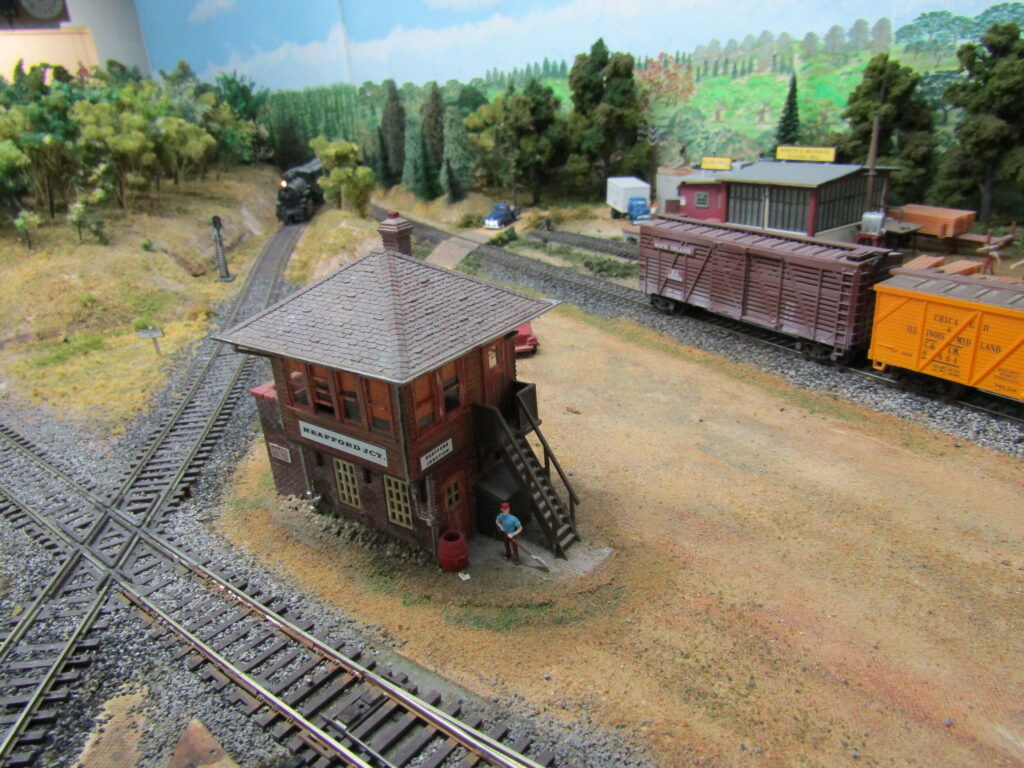
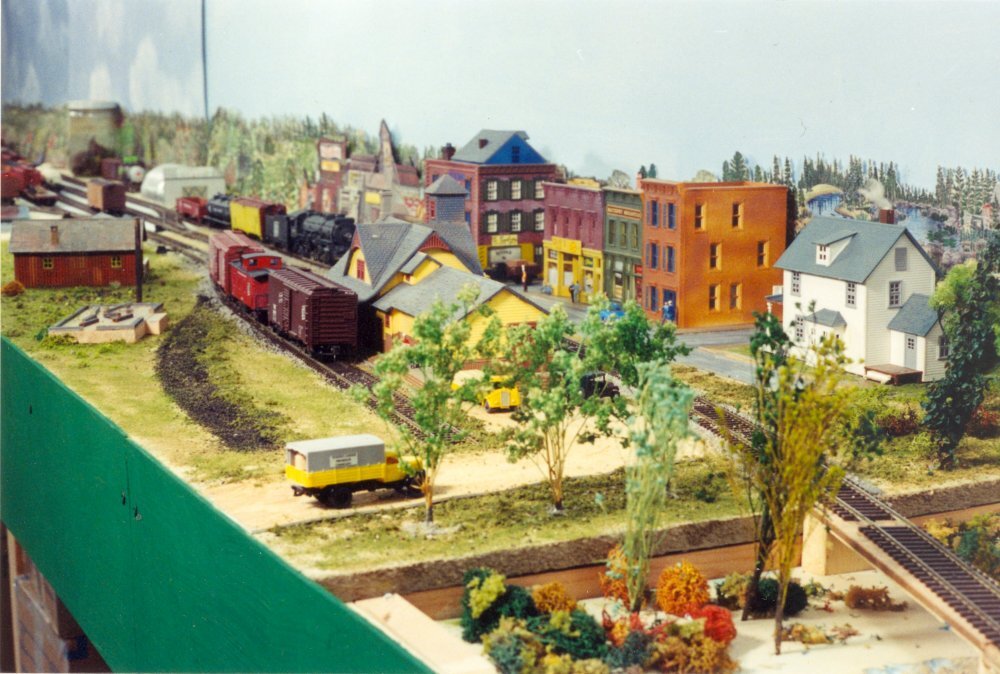
Heafford Junction hosts the Milwaukee Road interchange. The steamer in the background is forever dead except for the headlight. The two cars on the right are on the interchange track; Wixson & Bronson Planing Mill (motto with apologies to IBM: plane ahead) is in the background. Prue’s stamp-art backgrounds disguise the peninsula divider.
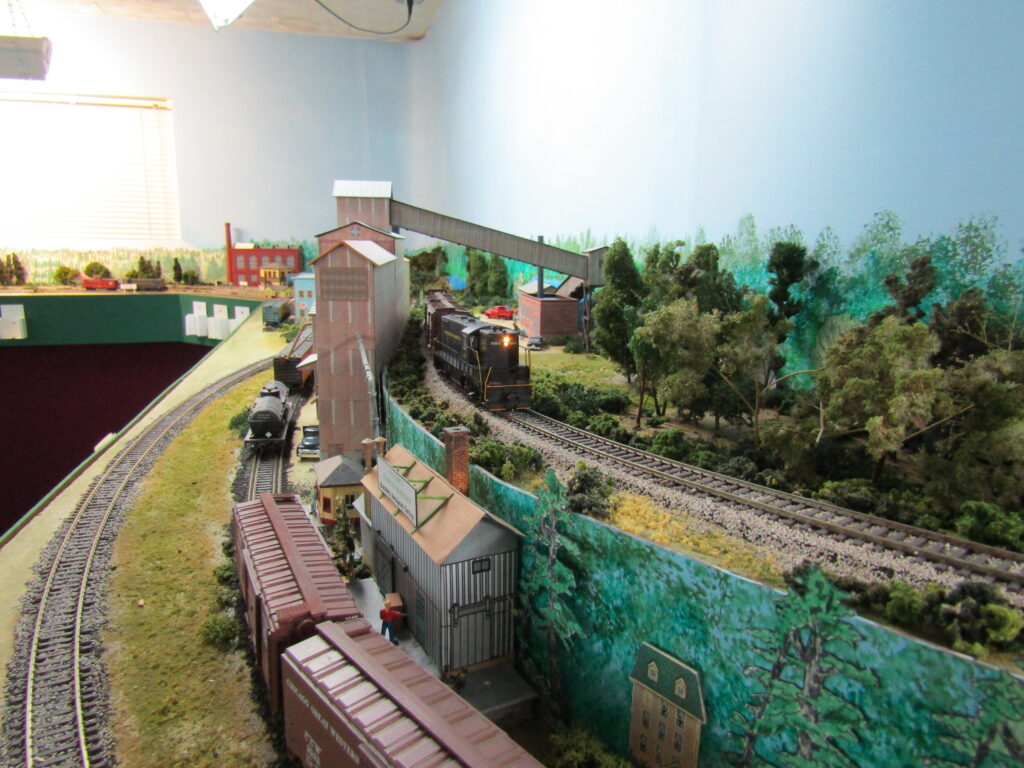
A manifest train climbs the 2.5% grade to staging, passing under the conveyor fetching flopping fish from the lake to the main building of Fred’s Floppin’ Frozen Fish Factory No. 2. Dave Roeder, MMR built this unique complex using printed paper on cardstock. FFFFF is a major supplier of frozen fish, fish eyes, and fish scales. Fossie’s small fish eye jewelry operation occupies the near building in the photo. A pipe flume spans the distance from FFFFF to Fossie’s. Fish scales, another by-product, are sold by the ton to a customer in Milwaukee. The HO scale Fairbanks Morse scale (i.e. a scale to weigh scales) is nestled between FFFFF and Flossie’s. It is modeled on the F-M scale in Rhinelander. Two photos of the prototype scale were published in the July 2012 MR “Mailcar”.
The following link will take you to the Johnson PSL page on the Arch Rails site with more information and photos: http://archrails.com/layouts/soo-johnson/.
The following link will take you to the Johnson PSL page at OperatingSessions.com: https://www.operatingsessions.com/Layouts/Johnson2.
The following link will take you to the Pseudo-Soo Line web page: https://pseudo-soolinemodelrailroad.net/cgi-sys/suspendedpage.cgi.
For more details on the PSL click here.