
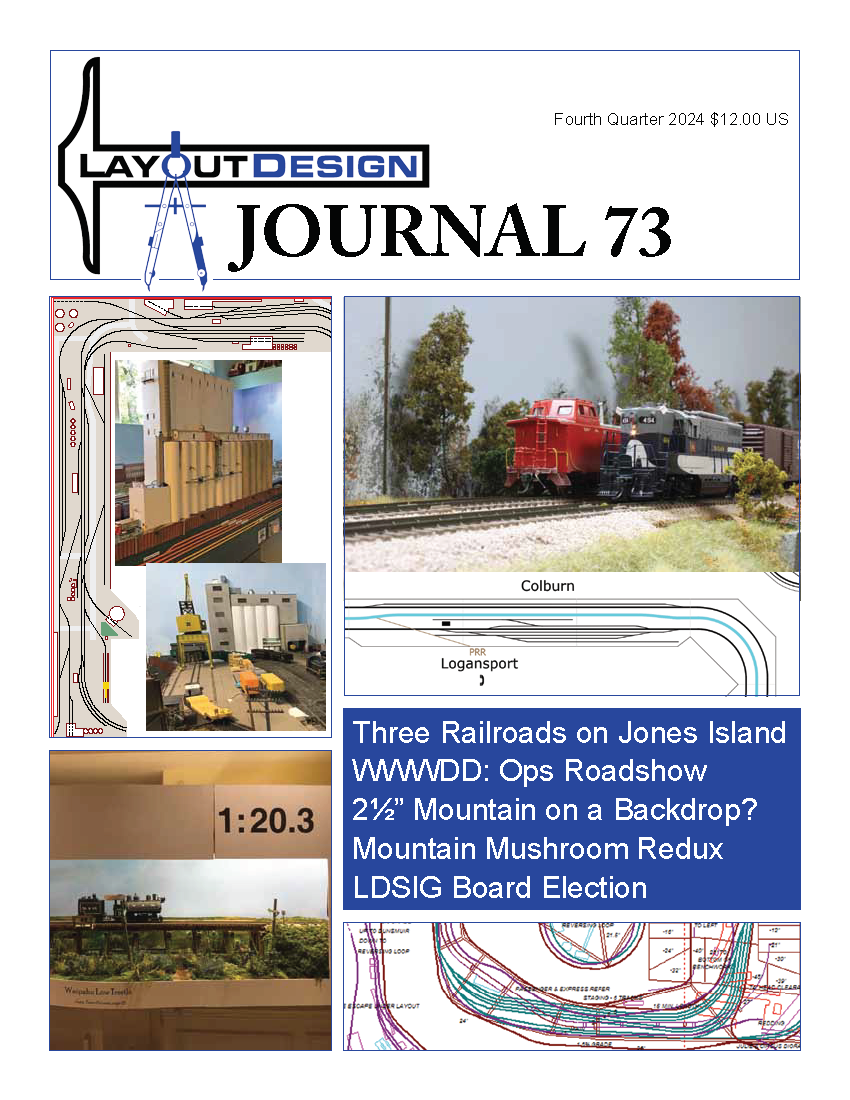
The Layout Design Journal (LDJ), Issue 73
The Layout Design Journal (LDJ), Issue 73 (Fourth Quarter 2024) includes Mark Nieting’s “Three Railroads on Jones Island,” describing the creation of a rail-marine HO switching layout in a 19’x14′ room, Nicholas Kalis’s “2½” Mountain on a Backdrop?” discussing techniques for creating convincing shallow-depth backdrops using museum display methods, and John Young’s “Rethinking the Ops Roadshow Layout,” a detailed look at evolving a modular operations-focused layout designed for Time Table and Train Order (TT&TO) instruction. Gary Ray’s “Mushroom Garage Shasta Division” offers an update with improved track plans on a multi-deck home layout project described in LDJ-72.
The issue also covers the LDSIG Board of Directors election, updates from the 2024 Annual General Meeting, and announcements for future LDSIG events and activities. Through these articles and reports, LDJ-73 provides a mix of layout design strategies, scenery techniques, prototype modeling inspiration, and organizational news aimed at helping modelers refine their craft and stay engaged with the LDSIG community.
Table of Contents
Features
Three Railroads on Jones Island Rail-marine HO switching in a “FROG” By Mark Nieting (p. 4)
2½” Mountain on a Backdrop? Lessons from museum professionals By Nicholas Kalis (p. 15)
Rethinking the Ops Roadshow Layout What Would We Do Differently: Concept, construction, and improvements By John Young (p. 20)
Remembering Mike O’Brien A tribute to a model railroading friend and leader (p. 31)
Mushroom Garage Shasta Division Building a unique mushroom layout in a garage space By Gary Ray (p. 38)
News and Departments
The More Things Change … Editorial reflections By Byron Henderson, LDJ Editor (p. 3)
Moving Into Fall and the Future President’s message By Ron Burkhardt, LDSIG President (p. 3)
Meetings and Upcoming Events Sacramento, San Luis Obispo, Novi MI meeting updates (p. 19)
LDSIG Board of Directors Election Election announcements and candidate profiles (p. 33)
LDSIG 2024 Annual General Meeting Report Summary of proceedings and updates (p. 37)
Detailed Article Summaries:
Title: “Three Railroads on Jones Island: Rail-Marine HO Switching in a FROG” Page 4
Author: Mark Nieting
Railroads Modeled: Milwaukee Road (MILW), Chicago & North Western (C&NW), and Chesapeake & Ohio (C&O)
Location: Proto-freelanced Jones Island area ; Milwaukee, WI
Era: late 1960’s to early 1970’s
Scale: HO
Size: Garage; 19′ x 14′ “Finished Room Over Garage” (FROG); with two-deck operational flow using a continuous loop and multiple local switching zones
Techniques: Prototype-inspired selective compression; dual-railroad operations; rail-marine interface modeling car ferry operation; integrated urban industrial design; large industrial buildings; custom scratchbuilt structures,; job flow; hand-written switchlists for operations; Google Earth; Sanborn Maps; modeling winter; commuter operation; terminal switching; shelf layout; two man crews; waterfront suggested with ‘steel’ facing
Article Summary:
Development of layout concept with his Givens and Druthers of Milwaukee’s Jones Island as it appeared in the late 1960s to early 1970s, creatively fitting three active railroads into a 19′ x 14′ space within the structural limitations of a finished room over a garage. MILW and CNW share trackage with active switching zones fed by MILW “Jones Transfers” and C&NW “Marsh Jobs,” from 2 track staging yards for each railroad supporting point-to-point operations A dispatcher (BA Tower operator) manages crossing traffic and connector track use. Key industries include oil yards, bulk cargo terminals, Louis Allis Motors, Continental Grain Elevator, salt loading facilities, MMSD chemical plant, car ferry leads, and the Heavy-Lift pier. C&O ferry operations are visually suggested with simplified ferry yard trackage and selective omission of complex ferry slip modeling. Mark discusses complex rail-marine traffic, heavy industry, and unique industrial switching challenges.
Revised: 2026-01-27
Title: 2½” Mountain on a Backdrop?: Lessons from Museum Professionals; Page 15
Author: Nicholas Kalis
Railroad Modeled: Oahu Sugar Company (Oahu Ry. & Land Co. referenced);
Location: Hawaii sugar operations
Era: WWII-era
Scale: Fn3 (1:20.3 narrow gauge for 3′ prototypes) with elements in O and HO scale for forced perspective
Size: Garage; 17′ x 24′ layout; minimum 62″ mainline radius
Techniques: Low-horizon backdrops,; MDF Backdrop material; concealed backdrop edges; forced perspective; shallow-depth benchwork; vignette scene construction; curved backdrops; mixed-scale scenic elements; museum-style diorama presentation; controlled horizon lines; historical display; display layout; signage; fascia labeling
Article Summary:
Nicholas Kalis details techniques derived from museum diorama design to create immersive scenes using shallow benchwork and low backdrops. His Oahu Sugar Company layout models multiple separated scenes as individual vignettes connected by a continuous mainline. Despite large-scale trains, the backdrop mountains are only 2½ inches tall.. Low horizons mimic real world viewpoints wjhere mountains appear near eye level rather than towering above. Smaller scale scenic elements (HO and O scale) like vehicles, fences, buildings, and palm trees blend with larger scale (Fn3) trains to extend depth naturally. The layout functions as a scenic narrative, highlighting specific historical and geographic moments rather than replicating full rail operations.
Revised 2026-01-27
Title: Rethinking the Ops Roadshow Layout: ‘What Would We Do Differently’: Concept, construction, more Page 20
Author: John Young (with contributions by Jeff Fryman, Bob Milhaupt, Fritz Milhaupt, and Al Robertson)
Railroad Modeled: Proto-based freelance version of the Wabash Railroad (WAB)
Location: Peru, Indiana to Tilton, Illinois
Era: 1964
Scale: HO
Size: 53′ x 24′ overall layout footprint; 400-foot mainline length; composed of 35 modular sections
Techniques: Modular layout construction; section joint considerations; TT&TO teaching layout; double-sided tall backdrops,; long single-track runs; aisle width; prototype-based freelance planning; dispatcher and operator training system; modular transportation logistics; reconfiguration planning.
Article Summary:
The Operations Road Show (ORS) was a pioneering project designed to teach Time Table and Train Order (TT&TO) operations with realistic scheduling, dispatching skills, train meets, and traffic density management at NMRA National Conventions through written materials, telephone communications, train orders, and supervised hands-on experience. Built 25 years ago, the modular layout models a busy, single-track segment of the Wabash Railroad between Peru, IN and Tilton, IL, circa 1964. Key design goals included passenger, through freight, locals, and extras; three train length running distances between towns, sincere (non-overlapping) scenic sections, tall backdrops for operator isolation to simulate dark territory, and full portability for convention travel.
Evolution and Lessons Learned (“What We Would Do Differently”):
Modular design restricted flexibility due to town scenes on both sides of modules. Future designs would reserve one side for simple single-track scenes only.
Layout set-up was complex and labor-intensive (6–19 hours). New modular designs from the Sipping and Switching Society (S&SS) suggest better approaches: integrated folding legs, casters, keyed module alignment, lightweight waffle-style modules, and consolidated wiring harnesses.
Original bridge tracks and separate subsystem cabling increased setup complexity; future designs would adopt pinned module alignment connections and combined wiring plugs.
Operational realism could be enhanced by including more signaling, better interlocking modeling at junctions, and automation for adjacent railroad interactions.
Revised: 2026-01-27
LDJ-73
Article: “Remembering Mike O’Brien: LDSIG Leader, Enthusiastic Operator, Creative Designer”
Author(s): Memories contributed by Bruce Morden, James Spencer, Seth Neumann
Techniques Highlighted: Master planning for layouts, three-dimensional thinking in design, layout design element integration, use of elevation changes, hand-drawn conceptual sketches, TT&TO training layout concepts, modular and portable layout strategies.
Railroad Modeled: Missouri-Kansas-Texas Railroad (MKT) ; Denison, Texas focus (unfinished at time of passing)
Scale: Not specifically stated; presumed HO Scale based on LDSIG participation history
Size: Personal home layout under construction with full basement MKT-themed layout intended
Article Summary:
This article honors Mike O’Brien’s wide-ranging contributions to the Layout Design Special Interest Group (LDSIG) and the model railroading community, focusing particularly on his talents as a layout planner, operator, and mentor. Professionally trained as an architect, Mike brought a spatial and master planning sensibility to layout design, emphasizing elevation relationships, scene isolation, and flow through three-dimensional scene planning.
Mike’s model railroading focus was the Missouri-Kansas-Texas (MKT) in Denison, Texas. He produced numerous layout plans before finally starting benchwork for his dream layout, which remained under construction at the time of his passing in July 2024. His design process favored hand-drawn sketches over pure CAD work, demonstrating an intuitive, spatially aware approach to scene composition and track planning focused on integrating operational purpose into layout design early. Mike developed portable, modular concepts for TT&TO operations training—such as hollow-core door layouts for NMRA conventions (Road Warrior Challenge entry, LDJ-42).
Mike also actively organized LDSIG activities at NMRA conventions (Long Beach 1996 and 2024) and was instrumental in LDSIG’s non-profit incorporation process, serving as its second President.
Revised: 2026-01-28
LDJ-73
Article: Garage SP Shasta Div. 1926 (From LDJ-72) Page 38
Author: Gary Ray
Railroad Modeled: Southern Pacific (SP)—Shasta Division
Location: Dunsmuir, California
Era: 1926
Scale: HO
Size: Garage-sized four-deck layout including visible Nutglade Yard
Techniques: Prototype-based multilevel design; stacked yard modeling; walk-under pit entrance; raised operator floor,; scene stacking by vertical compression,; modular visibility planning; CAD-based design, recovery from legacy software.
Summary:
Gary Ray’s SP Shasta Division layout is a four-deck, highly compressed, HO scale design intended to replicate the unique operational challenges of Dunsmuir, California, in 1926. The layout’s core innovation lies in accurately modeling two successive yards (Dunsmuir Yard and Nutglade Yard), reflecting how the Southern Pacific handled space constraints in the narrow canyon of the upper Sacramento River Valley. It utilizes a walk-under entrance pit and a raised floor for access to the upper decks.
Revised: 2026-01-28
Download a free sample of pages from this issue.
To download the issue login to your member account: click “here“.
Non-members can join or renew: Click “here“