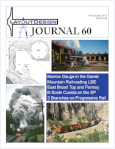
LDJ-60 FIRST QUARTER 2017 (FULL-COLOR, 40 PAGES)
Layout Design Journal Issue 60 (First Quarter 2017) centers on the theme of mountain railroading, narrow gauge ingenuity, and the creative adaptation of ambitious prototypes into constrained spaces. Each feature article presents unique solutions to the challenges of compression, steep grades, and complex scenery, while maintaining a strong emphasis on prototypical operations and fidelity. Don Mitchell’s Sn3 Denver, South Park & Pacific design in an attic garret exemplifies how to turn an irregular room with beams, low ceilings, and awkward access into a compelling narrow gauge mountain railroad. Robert Petrick’s Wind River Canyon design element demonstrates how dramatic scenery and engineering structures can anchor an entire layout, showing the potential of N scale to convey grandeur. Robert Reid’s East Broad Top and Pennsylvania Railroad plan captures the charm of narrow gauge coal operations alongside the power of Pennsy mainline freights, illustrating how two very different prototypes can coexist in a single layout. Byron Henderson’s N scale Cuesta Grade focuses on helper operations, Centralized Traffic Control, and lineal-based design, bringing Southern Pacific’s Coast Line to life with operational authenticity. Olaf Melhouse closes the issue with a freelance Progressive Rail design featuring three distinct industrial branches, emphasizing modular planning and switching interest.
Beyond the feature articles, the issue underscores the value of design challenges, member participation, and volunteer opportunities in sustaining LDSIG’s momentum. Taken together, Issue 60 reflects a balance between historical fidelity, freelanced inspiration, and the problem-solving ingenuity necessary to adapt real-world railroading drama into home layouts. It is both a showcase of technical strategies and a call to action for modelers to think creatively about space, operations, and realism.
Table of Contents
Features
Narrow Gauge in the Garret – Don Mitchell – p.4
Obstacles / Solutions / Gunnison Yard / Alpine Tunnel / Operations
Wind River Canyon Layout Design Element – Robert Petrick – p.10
Choosing Design Elements / Prototype Research / Construction Plans / Mirrors and Scenery
East Broad Top and Pennsy – Robert Reid, MMR – p.17
Longevity of EBT / Generous Standards / Compromises / Busy Short Line / Mighty Pennsy
Southern Pacific’s Cuesta in N Scale – Byron Henderson – p.20
Lineals Concept / Must-Have Scenes / Conceptual Planning / Footprint and Benchwork
Three Branches on Progressive Rail – Olaf P. Melhouse – p.35
Freelance Shortline Concept / Industrial Branches / Operations
News and Departments
Reluctant Reset – Byron Henderson – p.3
Don’t Miss the Opportunities – Ron Burkhardt – p.3
Membership and Back Issues Volunteers Needed – p.16
LDJ Back Issues Blowout Sale – p.16, 41
Future SIG Meets: Tulsa, OK; NMRA Orlando – p.38
LDJ Questions, Comments, Corrections – p.39
Narrow Gauge in the Garret
Author: Don Mitchell
Railroad Modeled: Denver, South Park & Pacific
Layout Scale: Sn3
Layout Size: 12’4″ x 13′ attic garret
Techniques: Multi-level design, duckunder, steep grades, selective compression
Don Mitchell presents an Sn3 Denver, South Park & Pacific layout built into a uniquely challenging attic room, with beams, sloping ceilings, and a low entryway. The design makes creative use of clearances above beams and doors to achieve multi-level routing, capturing signature scenes such as Gunnison Yard, the Palisades cliffs, and the Alpine Tunnel. Operations emphasize helper service, steep grades up to 3.5%, and turntable use instead of wyes. Despite space limitations, the layout conveys the rugged drama of Colorado narrow gauge railroading, showing how even difficult rooms can yield engaging prototype-inspired designs.
Wind River Canyon Layout Design Element
Author: Robert Petrick
Railroad Modeled: BNSF through Wind River Canyon
Layout Scale: N
Layout Size: 5′ x 14′ peninsula
Techniques: Freelanced-prototype, folded dogbone, mirrors, sectional benchwork
Robert Petrick details a dramatic N scale layout design element based on Wyoming’s Wind River Canyon. The design integrates canyon walls, the Wind River, Boysen Dam, tunnels, and bridges, compressed into a 5′ x 14′ peninsula. Mirrors are employed to double depth and create the illusion of scale. The construction emphasizes layered foam, plaster rockwork, and modular benchwork. With continuous double-track running and dramatic vertical scenery, the design demonstrates how a single geographic feature can anchor an entire layout, balancing scenic grandeur with realistic railroad operation.
East Broad Top and Pennsy
Author: Robert Reid, MMR
Railroad Modeled: East Broad Top (narrow gauge) and Pennsylvania Railroad
Layout Scale: HO (dual gauge representation possible)
Layout Size: 16′ x 22′ room with peninsula
Techniques: Double-decking, selective compression, interchange, helper grades
Robert Reid combines the narrow gauge East Broad Top with the mighty Pennsylvania Railroad in one HO scale design. The EBT hauls coal and ganister rock to Mount Union for interchange with the PRR, while the Pennsy mainline delivers heavy traffic through staging. The design includes selective compression, turntables instead of wyes, and a double-deck climb to Robertsdale. Operations include PRR freights and passenger trains alongside EBT’s coal movements, blending narrow gauge charm with standard gauge power. The layout captures the unique interchange character and operational richness of central Pennsylvania railroading.
Southern Pacific’s Cuesta in N Scale
Author: Byron Henderson
Railroad Modeled: Southern Pacific Coast Line (Cuesta Grade)
Layout Scale: N
Layout Size: 16′ x 22′ bonus room
Techniques: CTC, helper service, lineal-based design, multi-deck staging
Byron Henderson develops an N scale design of Southern Pacific’s Cuesta Grade, highlighting helper operations and Centralized Traffic Control. The layout features San Luis Obispo Yard, Stenner Creek Viaduct, the Big and Little Horseshoes, and summit tunnels. The design employs lineal planning to size sidings and yards for 30-car freights and 14-car passenger trains. Staging and spiral benchwork footprints ensure operational flow. The design reflects prototype fidelity and operational complexity while fitting within a constrained home space.
Three Branches on Progressive Rail
Author: Olaf P. Melhouse
Railroad Modeled: Progressive Rail (freelanced shortline)
Layout Scale: HO
Layout Size: Around-the-walls basement layout
Techniques: Branchline switching, modular design, industrial ops
Olaf Melhouse presents a freelance design inspired by Progressive Rail, a modern shortline. The layout incorporates three distinct industrial branches, each offering switching challenges and prototypical traffic patterns. The design emphasizes modularity, adaptability, and efficient use of space, allowing for evolving interests. The plan demonstrates how freelance railroads can deliver both realistic operations and flexibility while maintaining a strong prototypical flavor.
Download a free sample of pages from this issue.
To download the issue login to your member account: click “here“.
Non-members can join or renew: Click “here“