
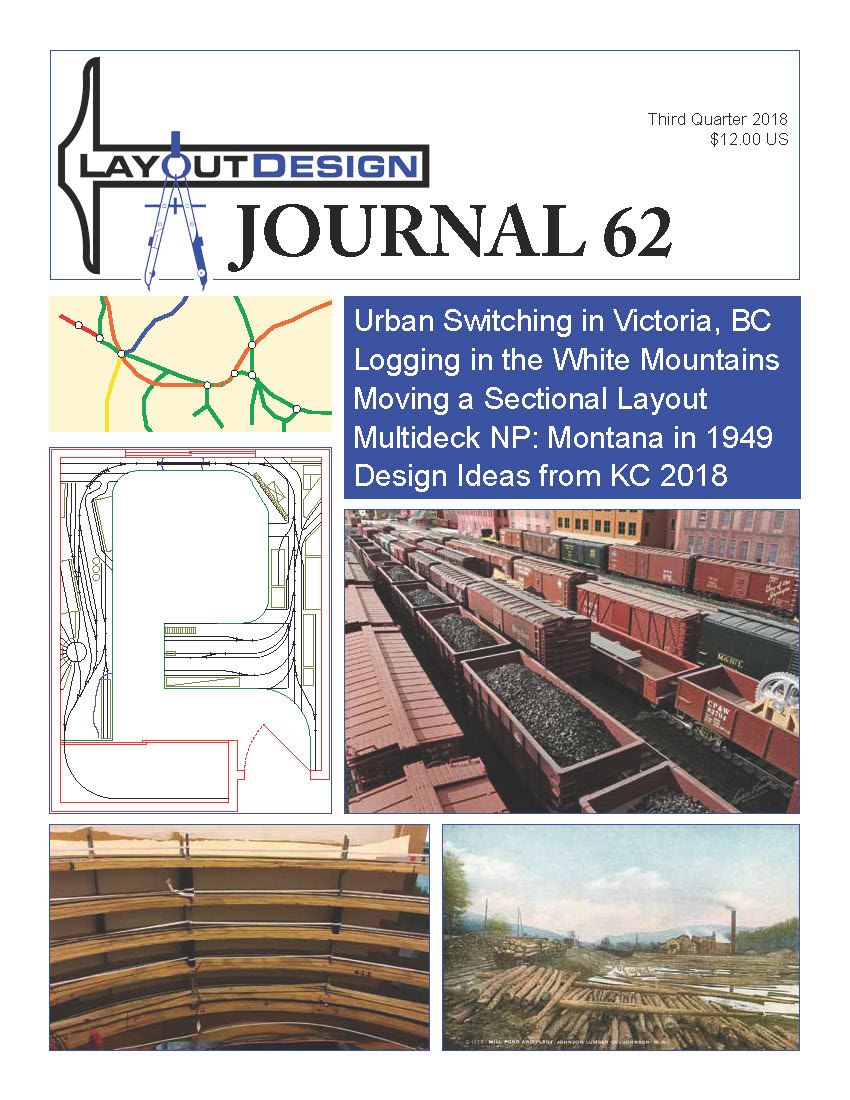
LDJ-62 THIRD QUARTER 2018 (FULL-COLOR, 40 PAGES)
1. Issue Summary
A diverse collection of design ideas centered on urban switching, sectional portability, historical prototypes, and lessons from regional conventions. A common theme across the issue is how layout designers adapt real-world railroading into accessible, operationally engaging models, whether through compression, sectional construction, or creative use of space.
Cal Sexsmith’s exploration of Canadian Pacific’s Esquimalt & Nanaimo trackage in Victoria, BC highlights the challenges and opportunities of modeling dense industrial districts. His three HO track plans balance Albion Yard, West Yard, and Store Street industries, emphasizing switching variety and the compromises necessary in limited space. John Brennan’s article demonstrates how sectional benchwork allowed his freelanced Chicago, Peoria & Western Railroad (CB&Q) to survive relocation intact, underscoring the value of modular construction and thoughtful wiring.
Carlos Rodriguez offers a historically rich N scale design of the Northern Pacific’s Rocky Mountain Division during the Mullan Pass Tunnel collapse of 1949. His multideck, nolix-based plan highlights helper operations, staging density, and the complexity of mountain railroading compressed into a manageable basement. Jeremy Dummler transports readers to the logging lines of New Hampshire’s White Mountains, showing how small logging railroads provide inspiration for compact yet operationally rich designs. Finally, Don Winn distills design ideas from the 2018 Kansas City NMRA convention, illustrating how peer exchange and collaborative critique continue to refine layout planning.
2. Table of Contents
Articles
Switching Victoria, BC on the E&N – Cal Sexsmith – p.4
Moving a Layout – John Brennan – p.11
Northern Pacific’s Rocky Mountain Division 1949 – Carlos O. Rodriguez, Jr. – p.17
Logging in the White Mountains – Jeremy Dummler – p.30
Design Ideas from Kansas City 2018 – Don Winn – p.40
News and Departments
Getting There – Byron Henderson – p.3
Rarin’ to Go – Ron Burkhardt – p.3
Call for Board of Directors Candidates – p.3
Board of Directors Election Report – p.29
LDSIG 2018 Annual General Meeting Minutes – p.39
Upcoming Events: New Jersey; SF Bay Area – p.39
3. Detailed Article Summaries
LDJ-62
Title: Switching Victoria, BC on the E&N; Albion Yard Anchors Three HO Versions Set In 1960; Page 4
Author: Cal Sexsmith
Series: Spare Room Switching Challenge, announced in LDJ-59Railroad Modeled: Esquimalt & Nanaimo; Canadian Pacific (CPR) subsidiary
Location: Vancouver, BC; Victoria, BC
Era: 1960s
Scale: HO
Size: Bedroom: 10’ x 10’10” plus closet (three versions)
Techniques: Urban switching, staging via closet, industry spurs, yard design; team tracks serving a large industry; small passenger station; rail car passenger traffic; car float; car space calculations; yard capacity considerations; modeling from track diagrams and maps; team yard design; yards on peninsulas; industry selection; truncating a roundhouse; interchange; terminus design; aisle spacing
Summary:
Three HO-scale design variations based on the Canadian Pacific’s Esquimalt & Nanaimo operations in Victoria, BC circa 1960. Anchored by Albion Yard and Store Street industries, the designs emphasize switching variety and industrial density. The article details how industries like Lucky Lager Brewery, Victoria Foundries, meat packers, grocery warehouses, and propane dealers created traffic diversity. West Yard, with roundhouse, shops, and car float, adds further operational interest. Comparison of versions with different aisle arrangements, trade-offs in yard capacity versus industry representation, and balance between prototype fidelity and model practicality. The designs highlight how crowded urban prototypes provide rich switching potential in modest spaces.
Revised: 2026-05-10
LDJ-62
Title: Moving a Layout: Sectional Construction and a Similar Space Allow Quick Rebuild; Page 11
Author: John Brennan
Railroad Modeled: Freelanced Chicago, Peoria & Western; based on Chicago Burlington & Quincy (CB&Q)
Location: Central Illinois
Era: September 1940
Scale: HO Layout
Size: Club: Original 30’ x 45’ basement; rebuilt 35’ x 45’ metal building
Techniques: Sectional benchwork, modular wiring, Digitrax DCC, steam-era ops; Active Mole staging yards; room preparations; live coal loads; moving/storing via trailer; changes after test operations; outbuilding to house existing layout.
Summary: Relocation of the Chicago, Peoria & Western layout from Illinois to Florida. Built with sectional benchwork and modular wiring, the HO layout was carefully disassembled, transported 1,350 miles, and reassembled in a new custom outbuilding. Brennan describes labeling, cutting, and bundling track sections, as well as storing locomotives, cars, and structures to avoid damage. Once reassembled, the layout resumed operations, modeling 1940s Illinois with steam power, live coal loads, and timetable/train order operations. His story underscores the benefits of sectional construction in preserving years of effort during relocation and how planning ahead enables continuity of operation even across major moves.
Revised: 2026-05-10
LDJ-62
Title: Northern Pacific’s Rocky Mountain Division 1949: Historical Tunnel Collapse Sets Stage for Multideck Design; Page 17
Series: Mountain Railroading Challenge, originating in LDJ-55
Author: Carlos O. Rodriguez, Jr.
Railroad Modeled: Northern Pacific (NP) Rocky Mountain Division
Location: Garrison to Logan, Montana; focus on Butte, MT
Era: 1949
Scale: N
Size: Garage; 16.5’ x 22’ multideck
Techniques: Nolix, helix staging, mushroom peninsula, helper operations, prototype-inspired operations; prototype research, historical events, construction techniques, conceptual design, operations planning, train scheduling, train length planning; shared engine facilities; trackage rights; passenger service; RDC; interchange; detour traffic; automated train operations; continuous run staging; minimum depth benchwork; aisle width considerations; train consists; TT&TO
Summary: An ambitious N scale proposed design recreating the Northern Pacific’s (NP) Rocky Mountain Division in 1949, the year the Mullan Pass Tunnel collapsed. This historical event forced NP to reroute all traffic over Homestake Pass, creating intense helper operations and detour traffic through Butte. Rodriguez’s plan uses a mushroom peninsula combined with an around-the-room nolix helix to provide over nine scale miles of mainline run. Extensive staging, helper districts, and interchange with Union Pacific (UP), Great Northern (GN), Milwaukee Road (MILW), and the Butte, Anaconda & Pacific (BA&P) create a dense web of operational opportunities. His conceptual plan balances mountain railroading drama with practical construction, providing inspiration for modelers drawn to big-time operations in a home setting.
Revised: 2026-05-10
LDJ-62
Title: Logging in the White Mountains: Mountain Challenge Layout Inspired by Postcards and More; Page 30
Series: Mountain Railroading Challenge, from LDJ-56
Author: Jeremy Dummler
Railroad Modeled: The Granite River Railroad; Proto-Freelance
Location: White Mountains, New Hampshire; Lincoln, NH
Era: Early 1900s
Scale: HO
Size: Garage; 16’ x 22’; multi-deck
Techniques: Logging operations, scenic emphasis, shortline design, staging; prototype research, prototype inspiration, helix, multi-deck, hiding a helix entrance, suggested reading references; shallow scenes; wide aisles; sawmills; seated operations; Boston & Maine (B&M) interchange; Doubling the hill; granite quarry
Summary: The logging operations of New Hampshire’s White Mountains provide inspiration for model railroads. He examines how small logging lines, with their rugged terrain, short trains, and specialized equipment, provide engaging themes for compact layouts. He emphasizes operational realism, from log camps to sawmills, and shows how selective compression can capture the flavor of backwoods railroading. He also notes the strong scenic opportunities provided by mountainous terrain, bridges, and trestles, making logging lines both visually striking and operationally rewarding
Revised: 2026-05-10.
LDJ-62
Title: Design Ideas Seen On Tour – Kansas City 2018; Page 40
Author: Don Winn
Railroad Modeled: Various (design convention ideas)-
Scale: N/A
Size: N/A
Techniques: Convention-inspired design strategies; helix construction, backdrop alternatives
Summary: Photo collection of design insights gained from the LDSIG’s activities at the 2018 NMRA National Convention in Kansas City, including protection of rolling stock from falls from a helix using rubber bands and using structures in place of double-sided backdrops..
Revised: 2026-05-10
Download a free sample of pages from this issue.
To download the issue login to your member account: click “here“.
Non-members can join or renew: Click “here“