
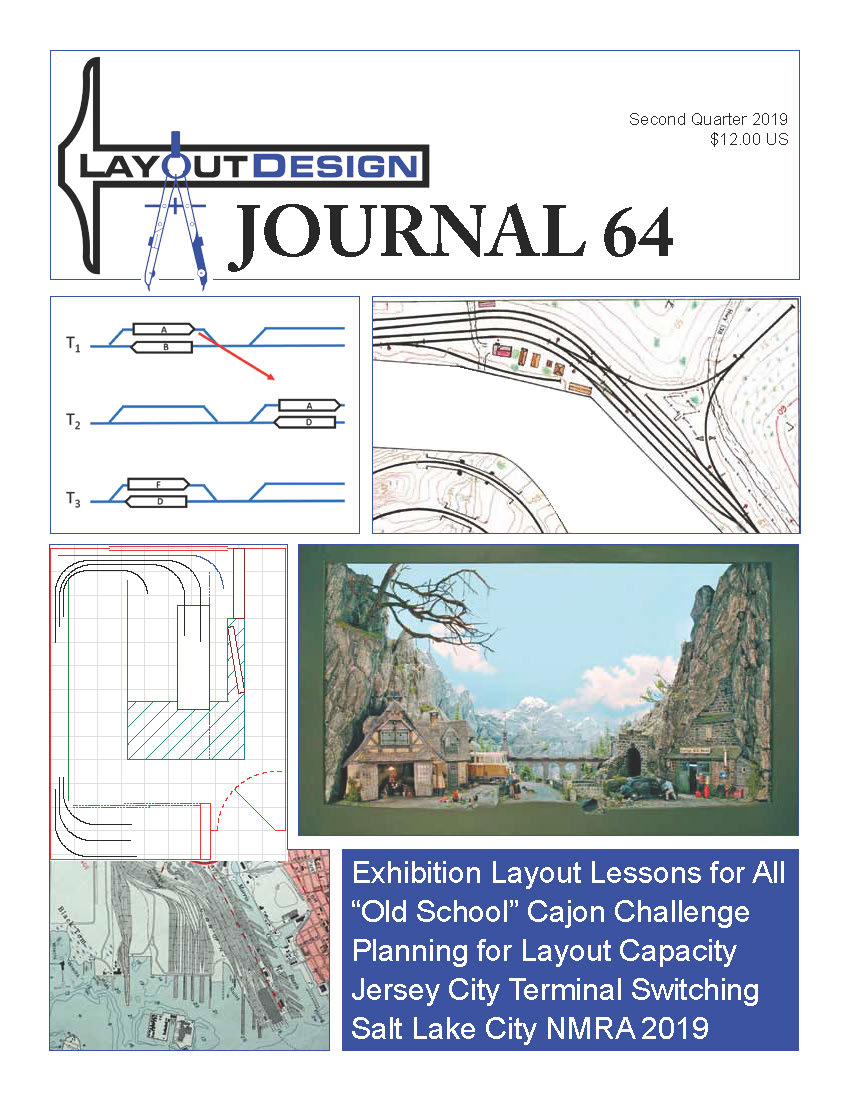
Layout Design Journal Issue #64 (Second Quarter 2019)
1. Magazine Summary
Issue #64 features Nicholas Kalis article highlighting visual storytelling techniques from a Swiss-themed exhibition layout. Rick Mugele provides a classic take on modeling Cajon Pass with hand-drawn plans as part of the Mountain Challenge from LDJ-55.
Paul Clegg offers a detailed theoretical guide to planning layout capacity based on prototype logic.
Design and operational potential found in a single, complex prototype setting: Jersey City’s waterfront rail terminals in the mid-20th century. The article emerges from a switching design challenge originally announced in LDJ-59, encouraging layout designers to reimagine the Port of New York (PONY) facilities—specifically the CNJ and LV terminals—within a 10×11 spare-room-sized space. This challenge emphasizes prototypical operations, marine terminal integration, and balancing historical density with modeler practicality, Including two Jersey City switching design challenge responses by Michael Pennie and Byron Henderson. These showcase realistic use of ferry slips, float bridges, coach yards, and passenger operations in compressed urban scenes.
Themes include rail-marine interchange, scene separation techniques, freight and passenger yard optimization, operator flow, and how prototype-based concepts can be thoughtfully compressed. A notable trend is the emphasis on N scale for space efficiency, but the principles apply broadly. Modelers are encouraged to consider not only spatial layout but visual pacing, operational flow, and staging logic.
2. Table of Contents
Articles
Design Lessons from B.A. Bodil – Nicholas Kalis – Page 4
“Old School” HO Cajon Pass – Rick Mugele– Page 9
Designing for Layout Capacity – Paul Clegg – Page 16
Port of New York in a Spare Room – Michael Pennie – Page 33
One PONY Jersey City Alternative Track Plan – Byron Henderson – Page 36
News and Departments
Thirty … and Counting – Byron Henderson – Page 3
Anticipation and Satisfaction – Ron Burkhardt – Page 3
Help! : Membership Volunteer Needed – LDSIG Board – Page 3
LDSIG Back Issues – Page 32
In Memorium: Bruce Notman – Page 39
LDSIG Activities at Salt Lake City NMRA 2019 – Page 40
3. Detailed Article Summaries
LDJ-64
Title: Design Lessons from B.A. Bodil: Exhibition-style masterpiece engages and inspires; Page 4
Author: Nicholas Kalis
Railroad Modeled: Freelance Alpine Theme (Switzerland)
Location: European Alps
Era: N/A
Scale: 1:25 ; 1:50; 1: 100; 1:400
Size: 0.75 square meters (approx. 8 square feet); exhibition diorama
Techniques: Exhibition layout; scenic storytelling; single scene; extreme compression; visual balance; backdrop integration; reduced scope for rapid completion; portability; forced perspective; animation; compact layouts; visually framing a scene; railbus; micro-layout; lighting; shadow box; Diorama
Summary: This article reviews the B.A. Bodil portable exhibition layout created by three European modelers: Peter Dillen, Hans van den Boom, and Hugo Baart. Despite a footprint of just 0.75 square meters, the layout tells a story rich in scenic narrative centered on a Swiss Alpine setting. Framed by an animated blacksmith shop on one end and an auto repair garage on the other, the valley scene includes towering painted mountain backdrops, animated figures, and finely detailed scenery. The builders used several scales to create the illusion of distance using forced perspective. Kalis emphasizes the layout’s balance among storytelling, excellent craftsmanship, and space and time to completion discipline—hallmarks of successful exhibition design and smaller spaces.
Revised: 2026-03-29
LDJ-64
Title: “Old School” HO Cajon Challenge: Mountain Challenge plan revisits ‘50s theme and approach; Page 9
Series: Mountain Challenge introduced in LDJ-55
Author: Rick Mugele
Railroad Modeled: Atchison Topeka & Santa Fe (ATSF), Union Pacific, (UP)
Location: Cajon Pass; San Bernadino to Summit, CA; Expansion to Victorville on proposed second deck
Era: 1956
Scale: HO
Size: Garage; 16 x22’; dogbone with peninsula; proposed second deck
Techniques: Single-level design; simple schematic; helper operations; curve and grade planning; prototype-inspired compression; scenic pacing; folded dogbone; walkalong scenic pacing; display operation; fiddle yard; standard design length; design tips for blobs; visible staging; immersion into the scene; prototype site visit; prototype operation; easy construction; low maintenance; no reversing section wye; basic DC wiring; access considerations; fiddle storage in drawers; minimizing layout depth; flyover; second layout plan introduces complexity; Yard Over Yard considerations;
Summary: Rick Mugele’s entry in the Cajon Pass Mountain Railroading Design Challenge announced in LDJ-55 and -56 blends traditional design methods and a classic scenic theme with practical modeler intuition. Using pencil, scale ruler, and “cut and paste” planning, Mugele compresses the dramatic topography and three-railroad traffic of California’s Cajon Pass into a single -deck HO scale layout. The design emphasizes helper action, elevation changes, and signature curves to recreate operational flow and scenic appeal depicted with prototype photos and a scripted operational scenario, without complex vertical layering. He discusses expansion possibilities and presents references for further reading about Cajon Pass.
Revised: 2026-03-29
LDJ-64
Title: Planning for Layout Capacity: Prototype lessons for the model; Page 18
Author: Paul Clegg
Railroad Modeled: N/A (theoretical/prototype analysis)
Location: N/A
Era: N/A
Scale: N/A
Size: N/A
Techniques: Capacity planning; train density; train operations design; siding spacing; dispatcher optimization; yard design; signal strategy; delay / wait time per train; fleeting trains; planned train length; Centralized Traffic Control (CTC), Track Warrant Control (TWC), Direct Traffic Control (DTC); yard congestion; infrastructure limitations; train priority; single track capacity; weaving trains through sidings; crew enjoyment; single track helix delays; effect of branch lines; location of branchline junction; average train length between sidings; double track near yards; way freight switching; over length trains; dispatcher workload; train spacing; avoiding yard congestion; block swapping;
Summary: An analytical guide to understanding and planning layout train capacity and train density for operations-oriented layouts based on prototype practices. Exploration of how siding length, train priority, dispatcher workload, and yard structure affect throughput. Diagrams and simulations support strategies like double-ended yards, block-swapping, and fleeting trains. He discusses train operations planning based on available trackage, speed, superiority, signaling, dispatcher workload, and switching time. This +Framework can avoid common capacity pitfalls and design layouts that can sustain complex operations without gridlock. A series of endnotes describes how prototypical methodologies can be applied to model railroads to adjust capacity for the available track infrastructure.
Revised: 2026-03-29
LDJ-64
Title: Port of New York in a Spare Room: Passenger and freight switching on the CNJ and LV; Page- 33
Series: Switching Operation Design Challenge originating in LDJ-59Author: Michael Pennie
Railroad Modeled: Central Railroad of New Jersey (CNJ) and Lehigh Valley (LV)
Location: Jersey City, NJ; New York Harbor
Era: 1955
Scale: N
Size: Spare Room: 10′ x 11’ plus closet for staging
Techniques: Urban density modeling; car float and lighter operations; staging; rail-marine interface; selective compression; freight and passenger switching; passenger terminal operation; curved turnouts; automated train operation; window access; aisle width; peninsula width; fascia accessories;
Summary The Design replicates CNJ and LV operations at Jersey City circa 1955 in a spare-room-sized N scale layout. It features car float yards, ferry slips, a commuter terminal, and freight docks. The plan models signature infrastructure (e.g., Johnson Ave, CNJ ferry terminal) using space saving curved turnouts, selective compression and removable scenic elements. Designed for up to three operators, it recreates the complex interaction of marine and rail services within a manageable space. Illustrated with photos and maps of the modeled area.
Revised: 2026-03-29
LDJ-64
Title: One detailed alternative for the Jersey City Terminal; Page 36
Series: Switching Operation Design Challenge originating in LDJ-59
Author: Byron Henderson
Railroad Modeled: Central Railroad of New Jersey (CNJ) and Lehigh Valley (LV)
Location: Jersey City, NJ; New York Harbor
Era: 1955
Scale: N Size: Spare Room; 10′ x 11’ plus closet for staging
Techniques: Scenic refinement; dual-operator planning; urban switching; staging integration; coach yard; ready tracks; visual pacing; removable benchwork and buildings; engine pockets; auto road as a scenic separator; car float operations; barge and lighter operation; rail-marine; aisle width; passenger terminal operation
Summary: Rework of Pennie’s plan enhances aisle flow and operational clarity while retaining key themes of passenger, freight, ferry and float service. He adds coach yard tracks, simplifies LV trackage, and adjusts operator working zones using scenic dividers. Curved turnouts and scene modulation to support smooth operation and realistic visuals. Compromises for train length are coordinated with staging capacity and operational considerations. The plan refines an already strong concept into a more practical, operational, and buildable layout.
Revised: 2026-03-29
Download a free sample of pages from this issue.
To download the issue login to your member account: click “here“.
Non-members can join or renew: Click “here“