
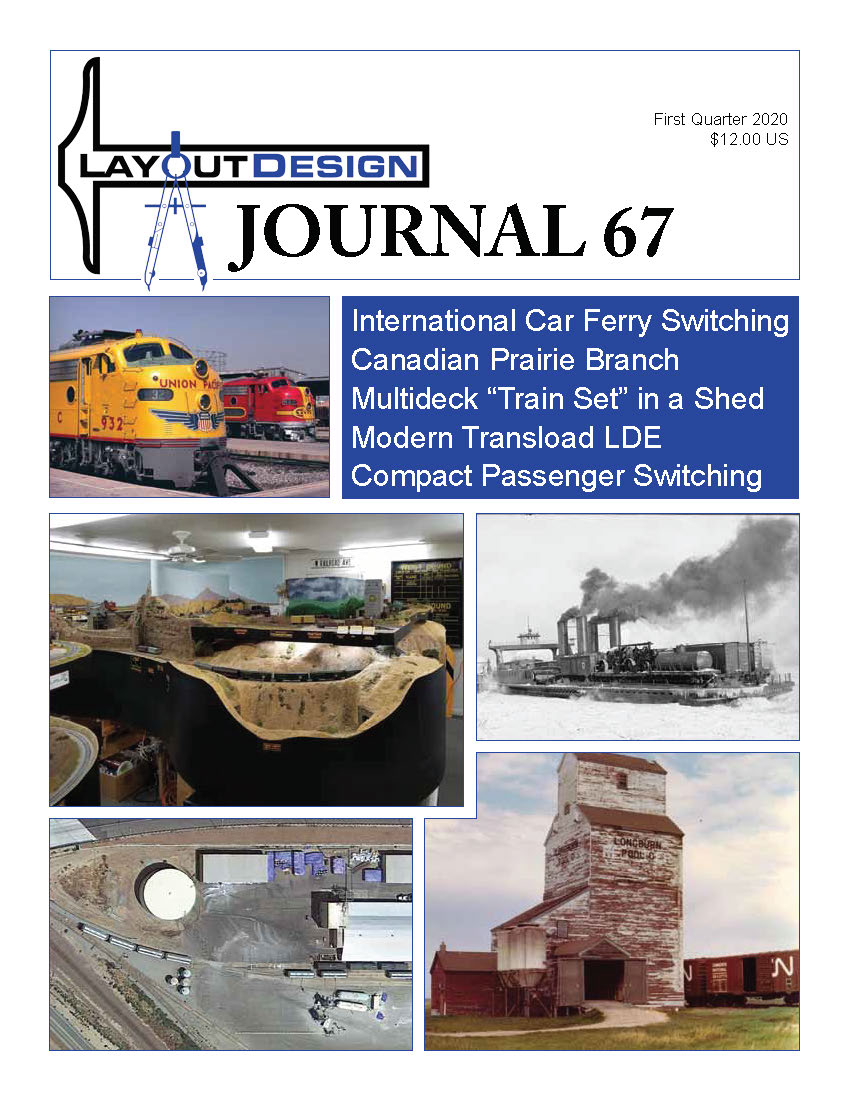
LDJ-67 FIRST QUARTER 2020 (FULL-COLOR, 40 PAGES)
This issue of Layout Design Journal 67 presents a range of layout planning ideas and real-world inspirations, showcasing six featured designs that focus on switching operations, compact multi-deck modeling, transload facilities, and effective passenger switching within tight spaces. Each article offers a thorough exploration of both prototype practices and modeling techniques, with plans scaled primarily for HO layouts and designed to fit realistically into limited spaces. The issue emphasizes freelance design grounded in prototype operations and includes both urban industrial settings and rural branch lines, with layered construction strategies and modern car handling.
Table of Contents
Articles:
International Car Ferry Switching Challenge by Bob Osborn – Page 4
Freelanced Canadian Prairie Branch by Russ Bonny – Page 12
Proto-Freelance Multideck Morada Belt by Dave Stanley – Page 20
Modern Transload LDE Inspiration by Byron Henderson – Page 29
HO Passenger Action in Spare Room by Byron Henderson – Page 35
Columns:
Let’s be Real by Byron Henderson – Page 3
The Doldrums by Ron Burkhardt – Page 3
Promote the SIG, Help the Journal – Page 33
Board of Directors Election Report by Robert Hanmer – Page 34
Future Meets: St. Louis NMRA; New Jersey – Page 34
Article Summaries
LDJ-67
Title: International Car Ferry Switching:: Detroit and Windsor on unconnected decks for HO challenge; Page 4
Series: Switching Design Challenge from LDJ-59
Author: Bob Osborn
Railroads Modeled: Wabash Railroad; Canadian Pacific; Michigan Central
Location: Detroit, MI; Windsor, ON
Era: Mid-1960’s
Scale: HO
Size: Spare Room; Two Decks each approximately 10′ x 11’; unconnected decks
Techniques: Dual-deck operation with unconnected decks; manual float transfer; urban industrial switching; compact yard operations; rail-marine; railroad ferry; carfloats; deck elevation; deck depth; reach
Article Summary: This article describes an HO layout design based on Detroit–Windsor railroad ferry operations in the 1960s. The model features unconnected upper and lower decks representing Windsor (CP) and Detroit (Wabash), respectively, simulating car float movement across the Detroit River. Operators switch local industries before reloading floats for transfer. The unconnected deck design creatively uses manual handling of car floats to simulate ferry movement and avoids the need for helixes or grades. Detroit industries modeled include Ford Rouge, Fisher Body, US Steel, Stroh’s Brewery, Detroit Produce Terminal, and Park Davis Pharmaceuticals. CP industries include Chrysler Engine Plant, GM Transmission, and Hiram Walker distillery.
Revised: 2026-02-15
LDJ-67
Title: Freelanced Canadian Prairie Branch: Imagining a Manitoba line prospering in a kinder world; Page 12
Series: Railfan, Display, Scenery, and Fantasy Challenge originally posted in LDJ-65; Page 34
Author: Russ Bonny
Railroads Modeled: Canadian National (CN)-inspired freelance line; Northern Pacific (NP); Portage & Northwestern (P&NW); Great Northern (GN)Location: Winnipeg; Portage la Prairie; Alonsa, Tontogan, western shore of Lake Manitoba, Canada
Era: 1971 to present
Scale: HO
Size: Club; 30 x 43; point to point
Techniques: Freelance branch line; grain and agricultural traffic focus; removable cassette staging; simple trackwork; alternative history; one turn helix; aisle width; interchange
Article Summary: HO scale layout inspired by prairie branch lines in Alberta and Saskatchewan. Designed to fit on shelves with removable staging, the layout features towns like Warren and Darby with grain elevators, agricultural suppliers, and team tracks. Emphasis is placed on single-operator session logic and natural scenery. The plan integrates CN-like structures and operations but remains freelance in design. Includes location map, schematic, and operational scheme with car spot matrix.
Revised: 2026-02-15;
LDJ-67
Title: Proto-Freelance Multideck Morada Belt: Pro railroader’s multideck “train set in a shed”; Page 20
Author: Dave Stanley
Railroads: Proto-freelanced Morada Belt Line, loosely based on Southern Pacific (SP); Central California Traction (CCT)
Location: Central California
Era: 1971 to present
Scale: HO
Size: Garage; 20′ x 20′; Multideck layout in a shed
Techniques: three operational decks; viewports for hidden track; scenic compression; use of JMRI Ops; foam and Celluclay scenery; digitally drawn backdrops; yard design; one turn helixes for scenic purposes; aisle compromise; multideck construction; logging branch
Article Summary: Dave Stanley outlines the construction and design of a proto-freelanced multideck layout set in California’s Central Valley. The Morada Belt features staging, mid-level yard (Morada), upper deck rural towns (Acampo, Ridgewood), and an agriculturally based branch line. A highlight is the Eagle’s Nest bridge scene between two one turn helixes. Construction Techniques include three single turn spirals, layered construction using custom steel brackets and L-girder benchwork. The layout blends SP-inspired scenery with freelanced operations and modern era freight flows. Scenic details and backdrops are created using layered techniques with artist John Signor’s help. Dave uses his prototype railroad experience to develop efficient track arrangements taking into mind aisle width and isolation of as many scenes as possible using view blocks containing murals.
Revised: 2026-02-06
LDJ-67
Title: Modern Transload LDE Inspiration: Layout Design Element for single-car railroading; Page 29
Author: Byron Henderson
Railroads Modeled: BNSF, Freelance/modern era
Location: Bakersfield, CA
Era: 1980 to present
Scale: HO
Size: Compact; LDE-style portion of larger layout
Techniques: Prototype LDE inspiration; operations-focused switching design; transload and truck facility interface; variety of car types; storage-in-transit
Article Summary: Modern transload sites as inspiration for incorporation into a layout design. With the decline of traditional industrial rail customers, transload sites offer contemporary relevance and are ideal for modeling on narrow shelves. Byron shows how to develop a layout from aerial photos, with emphasis on vehicle and rail interaction and practical, real-world geometry. Layouts based on these concepts can feature modern equipment and serve as realistic operational centers for boxcars, centerbeams, flat cars, and tank cars.
Revised: 2026-02-15;
LDJ-67
Title: HO Passenger Action in Spare Room: Somewhere West, The Family Room, and the Keyhole; Page 35
Series: Switching Design in a Small Bedroom Challenge originating in LDJ-59
Author: Byron Henderson
Railroads Modeled: Fictional commuter and intercity line
Location: Western US
Era: 1980 to present
Scale: HO
Size: Spare Room; 10 x 11 plus 2 x 6 closet; Terminal operations
Techniques: Passenger terminal design; use of crossovers and balloon track; clothes closet staging; dust shield; under layout storage; train-length wye; passenger switching; footprint development and iteration; duckunder; keyhole shaped access operating position; straight leg of turnouts for backing passenger cars; platform width
Article Summary: Byron presents two designs for a small passenger terminal layout focused on serious switching for commuter and intercity operations, with compromises to fit in a spare room. The first features continuous running and reverse loops. The second iteration focuses on terminal operations, including engine service, switcher pocket, head end switching, Pullman service, innovative staging in a clothes closet, turing wye, and a coach yard in a terminal to staging schematic. An operational scenario is included. A comfortable area for visitors and operators is included. A duckunder is used for access to an operator position, with suggestions for minimizing benchwork depth.
Revised: 2026-02-15
Download a free sample of pages from this issue.
To download the issue login to your member account: click “here“.
Non-members can join or renew: Click “here“