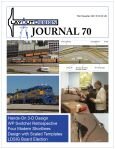
LDJ-70 THIRD QUARTER 2021 (FULL-COLOR, 40 PAGES)
Issue #70 Centers on how layout builders can balance detailed digital planning with physical mock-ups and iterative, hands-on experimentation. It demonstrates that even in an era of advanced CAD and automation, the physical act of laying track and visually testing scenes remains a powerful—and often necessary—tool in achieving prototypical fidelity and satisfying operations.
Don Winn’s lead article, Hands-On 3-D Design, captures this theme perfectly. He recounts the evolution of his HO-scale CB&Q layout’s West Batavia Branch through multiple on-the-bench revisions, incorporating physical track, industry mockups, and cardboard templates to make iterative improvements. This process reveals the critical gaps that CAD alone can’t always bridge—such as sightlines, reach, and visual mass.
Michael Hardwick follows with a thoughtful retrospective on his compact N-scale Western Pacific layout. He explores operations in tight spaces, the design of custom staging and structure, lighting systems, and a wide range of scratch building techniques, all while reflecting on how goals, experimentation, and limitations shaped his layout’s unique personality.
Further contributions include practical advice on using physical track planning templates from Steve Moore and Byron Henderson, plus four compact modern shortline designs by Olaf Melhouse that offer contemporary operations for modest spaces. The issue concludes with Henderson’s entry in the “Ten Turnout Challenge,” underscoring the value of small-layout problem-solving as both an exercise and a modeling approach.
Overall, this issue emphasizes experimentation, realistic operations in small footprints, and the enduring value of physical design practices. Whether readers lean toward CAD or cardboard, the takeaway is clear: great design comes from seeing, tweaking, and rethinking—sometimes with your hands, not just your mouse.
Table of Contents
Articles
Hands-On 3-D Design – Don Winn – Page 4
WP San Jose Retrospective – Michael Hardwick – Page 14
Layout Design with Scaled Templates – Steve Moore with Byron Henderson – Page 22
Designing Four Modern Shortlines – Olaf Melhouse – Page 25
Ten Turnout (or Fewer!) Design Challenge — Page 38
Midwestern Switching in Ten – Byron Henderson – Page 39
Ten Turnout (or Fewer!) Design Challenge — Page 38
Midwestern Switching in Ten – Byron Henderson – Page 39
Columns / Departments
Virtual and Vital – Byron Henderson – Page 3
Volunteer Associate Editors Needed – Page 35
LDSIG Board of Directors Election – Page 36
Meetings: SF Bay Feb., St. Louis NMRA Aug. 2022 – Page 36
Detailed Article Summaries
Title: Hands-On 3-D Design: Left-brain and right-brain extensions to CAD; Page 4
Author: Don Winn
Railroad Modeled: CB&Q (Burlington Route)); West Batavia Branch
Location: Aurora, IL
Era: 1966
Layout Scale: HO
Layout Size: 31’ × 45
Techniques: CAD planning,;, iterative track mockups, fascia flats;, hands-on testing, operating with temporary track, JMRI operations; Dead Rail, structure mockups; sight lines; learning from early operating sessions
Article Summary:
Design evolution of the West Batavia Branch, part of a larger HO-scale CB&Q layout. was described in LDJ-65. While initially planned in 3rd PlanIt CAD software, Winn adopts a physical approach— transferring reference points from the drawing to the benchwork, mocking up track arrangements with real turnouts and cereal-box industry flats. Through five design iterations, he relocates turnout placements, industry spacing, and track geometry, particularly to accommodate large signature industries like the Barber-Greene-factory complex. The layout benefits from insights gained during mock operating sessions and hands-on sightline testing. Techniques include fascia flats, angled spurs for visibility, Dead Rail battery locomotives, and use of JMRI Operations. The article advocates for a hybrid design approach—using CAD for overall planning and real-world mockups for detailed refinement.
Revised: 2026-01-02
Title: WP San Jose Retrospective: Design goals, unexpected learnings, successes; Page 14
Author: Michael Hardwick
Railroad Modeled: Western Pacific San Jose Branch
Location: San Jose, CA
Era: 1962
Layout Scale: N
Layout Size: 10’ x 18” with 6’ staging extension.
Location: San Jose, CA
Techniques:
Urban switching,;, historical fidelity,;, fascia flats,;, structure lighting with iPhone backlights, JMRI OperationsPro, push button staging traverser,;, scratch building,;, silicone casting,;, backdrop imaging,;, modular sectional design; steel plate section alignment; operations with purpose; meaningful car movements; limiting spur occupancy; interchange; historical research; fencing
Article Summary:
The highly detailed Western Pacific San Jose Branch layout was originally described in LDJ-58 and LDJ-61. Designed for operations and experimentation, the layout features industry-dense switching across just 15 square feet. of shelf, based on a WP track diagram. The layout combines operations planning using JMRI, urban scenery with custom fascia flats, and a novel staging traverser built with a stepper motor. He also introduces innovative structure lighting techniques using iPhone backlight films and discusses lessons from structure scratchbuilding, static grass application, and backdrop creation using layered digital images. His layout serves as a proving ground for techniques both traditional and high-tech, delivering a rich modeling experience in a small space.
Revised: 2026-01-02
Title: Layout Design with Scaled Templates: A quick way to start designing buildable track plans; Page 22
Author: Steve Moore with Byron Henderson
Railroad Modeled: N/A (general planning tools)
Layout Scale: All scales (template-based design)
Layout Size: N/A
Techniques: Manual design, use of scaled templates, analog layout planning, KISS Method templates, space planning, hand drawing planning, track planning tools, easement spirals, frog angles
Article Summary:
Steve Moore and Byron Henderson champion traditional layout design using physical templates as alternatives to CAD. They discuss the benefits of using scaled tools—like turnout templates and curve guides—to draw buildable plans by hand. They explain how to measure space, determine benchwork, define standards (e.g., minimum radius, turnout sizes), and iteratively refine a design without a computer. For modelers uninterested in mastering CAD, this method remains efficient, accurate, and creatively liberating. A set of flexible templates from KISS Method Inc. is reviewed to demonstrate practical application.
Revised: 2026-01-11
Title: Designing Four Modern Shortlines: Class 1 connections and lots of switching; p. 25
Author: Olaf Melhouse
Railroad Modeled: Proto-freelanced modern shortlines; Fort Worth & Western mainline in N scale;
Location: Fort Worth and Cresson to Dublin, TX
Era: 2014-2016
Layout Scale: N
Layout Size: 13 x 14’
Techniques: Modern industry industrial modeling; simplified staging; prototype modeling; continuous running; 3’ aisles; interchange; branch line operations; through trains; turns; branch line staging
Railroad Modeled: Fort Worth & Western; Gorman Sub
Location: Dublin to Gorman, TX
Era: 2014-2016
Layout Scale: HO
Layout Size: 12 x 12’
Techniques:
Branch line operation; 3’ aisles; point to point; open staging; peanut industry switching; short run around tracks
Railroad Modeled: Dakota Northern RR Walhalla Subdivision
Location: Grafton to Walhalla, ND
Era: 2012-2015
Layout Scale: N
Layout Size: 12 x 14’
Techniques: Branch line operation; 3’ aisles; point to point; BNSF interchange; agricultural industries; track warrants; typical Granger town arrangements and industries
Railroad Modeled: Dakota, Missouri Valley & Western
Location: Bismark to Max, ND
Era: 2021
Layout Scale: N
Layout Size: 12 x 14’
Techniques: Continuous run staging; local switching; 3’ aisles; prototype modeling; BNSF interchange; CP interchange; ethanol plant; agricultural industries; wye for turning; typical Granger town arrangements and industries
Article Summary:
Four HO-scale designs inspired by real modern shortlines, tailored to modest layout spaces and agricultural operations. Each design models a believable setting, including interchanges with Class 1 roads, contemporary industry, and simplified operations. His goal is to offer modern realism without needing the space for full-length unit trains. The article provides sketched layout plans and describes how each concept can capture the essence of contemporary shortline operations. It’s an accessible path to modeling today’s railroading without overwhelming space or complexity.
Revised: 2026-01-11
Title: Ten Turnout (or Fewer!) Design Challenge; p. 38
Author: Byron Henderson
Series: Ten-Turnout Challenge (introduced in LDJ- 69, Page 39)
Detailed Article Summary: Challenge to modelers to restrict a layout to 10 turnouts in an encouragement to focus, refine, and simplify. All scales, eras, room sizes, themes, and locations are allowed. Submissions to be published in future issues. The common denominator is to see what designers can creatively suggest within the 10 turnout limitation.
Revised: 2026-01-11
Title: Midwestern Switching in Ten: Relaxed realism on pre-built benchwork; page. 39
Author: Byron Henderson
Series: Ten-Turnout Challenge (introduced in LDJ-69)
Railroad Modeled: Freelanced Midwestern town
Location: Midwest
ERA: 1950’s
Layout Scale: HO
Layout Size: 8’ x 12’, L-shaped shelf style
Techniques: Ten-turnout challenge,;, operations-focused design, rural scenery, drop leaf staging
Summary:
A 10-Turnout Challenge entry focused on creating satisfying operations using no more than ten turnouts. His fictional Midwestern town layout uses industry switching, urban scenery, and cassette staging to deliver compact but realistic operations. Designed to fit in a limited space, the layout demonstrates how track planning fundamentals, such as track not paralleling the edge of the benchwork and allowing track length to simulate room for loading can yield strong scenic and operating potential even under strict constraints. The plan is ideal for small-space hobbyists or those exploring minimalist design.
Revised: 2026-01-11
Download a free sample of pages from this issue.
To download the issue login to your member account: click “here“.
Non-members can join or renew: Click “here“